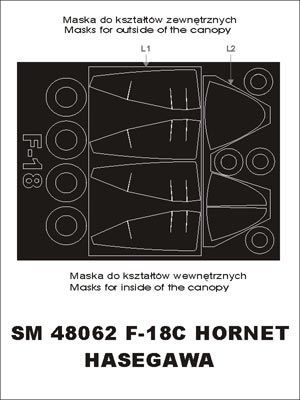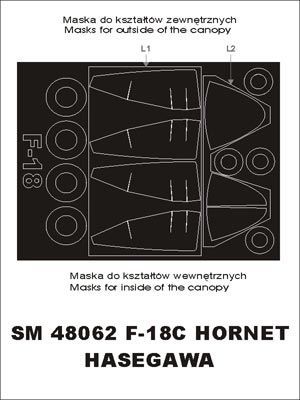
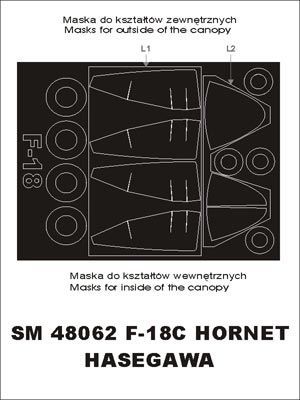
Masking films for the cockpit of the carrier-based Hornet in 1:48 scale. The shapes are cut to the Hasegawa kit and cover the glazing from outside and from the opposite side.
Responsibility details are not available.
The Hornet grew out of the YF-17 prototype and the US Navy chose it because it wanted a single aircraft able to take off in the morning as a fighter and come back in the afternoon with bombs under its wings. It entered service in the first half of the 1980s, served with the Navy and with the Marine Corps, and first saw combat use in that decade. Its recognition features are the two canted vertical tail surfaces and the massive wing leading-edge extensions, which keep the machine agile even at high angles of attack.
Unlike propeller machines, this aircraft has a cockpit made up of only two main parts, the windscreen and the hinged teardrop section. There are few frames, then, but they are wide and they run over a rounded surface. That is exactly where lining by hand fails, because a brush wanders on a curve and the edge ripples. A cut shape holds the line by itself.
The sheet is of thin self-adhesive film that can be shaped slightly as it is applied. Once the transparent part has been washed and dried, the templates are transferred one by one with tweezers. Anyone building the model with the cockpit open will also use the shapes meant for the inner surface, because the framing is just as conspicuous from inside. The paint is applied in thin coats and the film is taken off shortly after it has dried.
Naši poradci a znalci sortimentu jsou připraveni odpovídat na Vaše dotazy (Po–Pá, 8–18 hod).
Zeptejte se na co potřebujete, odpovíme co nejdříve.
Texts from customers in the advice section reflect solely the opinions and views of the customers. MNF trade s.r.o. does not approve or verify customer texts in advance.
There are no questions here yet. Be the first to ask!