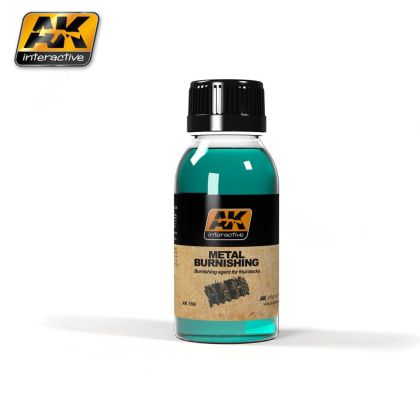
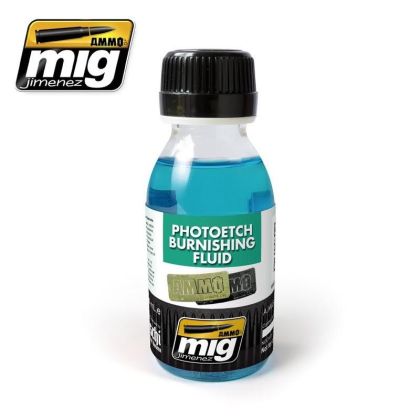
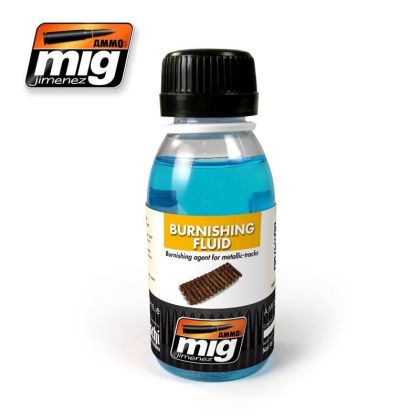
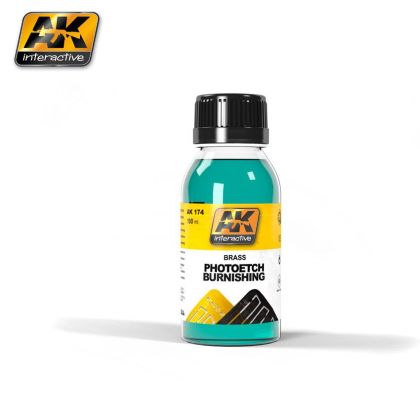
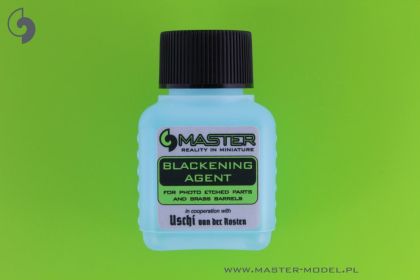
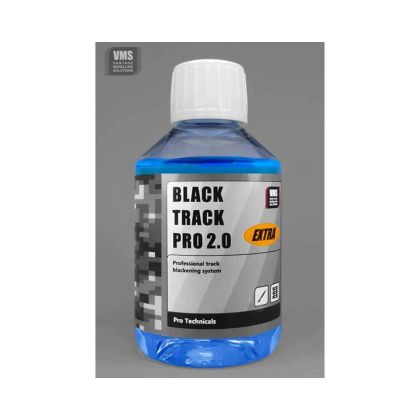
Blackening agents chemically darken bare metal to a deep, matt tone. They are used on photo-etched parts, brass barrels, metal tracks and small metal fittings, where raw shine instantly gives away that a part was added. Unlike paint, nothing is laid on top: the colour forms by reaction within the surface itself, so the finest etched detail stays open and nothing can flake off when a part is bent.
Below is the procedure, including the degreasing step without which the reaction simply will not start, and a note on which metals respond.
Photo-etched parts carry detail measured in hundredths of a millimetre. Every coat of paint partly fills it, and on fine mesh, straps and lettering it vanishes completely. A burnishing fluid does not have this problem, because the colour comes from a reaction in the surface — thickness is unchanged and relief untouched.
The second reason is mechanical. Paint grips smooth metal poorly and cracks when etch is folded. A chemically darkened surface bends with the part, because it is not a layer sitting on top but part of the metal.
On a greasy surface the reaction either will not happen or comes out blotchy. Degrease the parts carefully and from that moment handle them with tweezers, not fingers. A fingerprint will show in the result.
Brush the fluid on or dip the part into it. Darkening happens in front of you, so you stay in control: the moment the tone is right, rinse with water and the reaction stops. Longer immersion gives a darker, flatter surface, a brief dip only a hint of patina.
Let the part dry completely after rinsing. The surface is often slightly powdery; a gentle wipe with a dry cloth evens it out and brings the tone up. Where a part will be handled, sealing it with a thin matt coat is worth the extra step.
These products are formulated for particular metals — most often brass, copper and bronze, the materials etched frets and turned barrels are made from. On stainless steel, aluminium or tinned parts the reaction may not happen at all. Always test on a piece of fret you will not use.
The remaining auxiliary products are under modelling chemicals. A blackened fret blends into a model at once — it is among the quickest ways to stop a metal part reading as a foreign object.