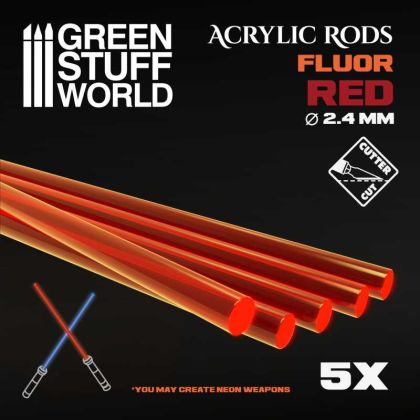
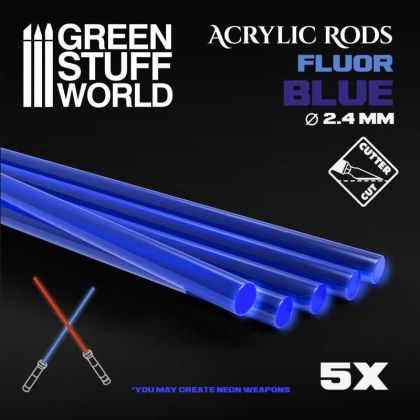
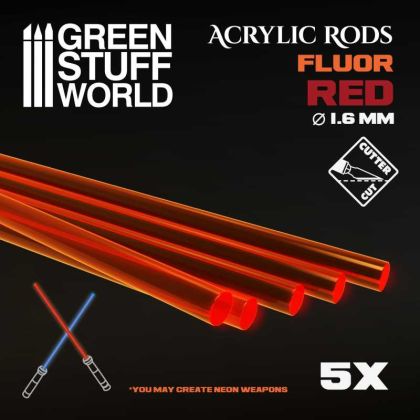
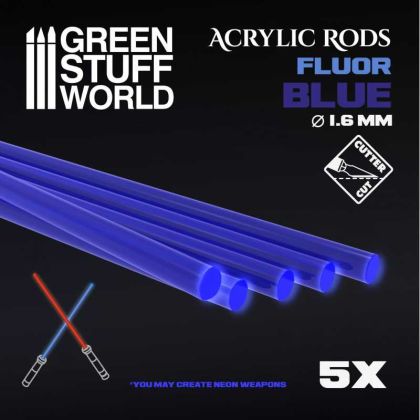
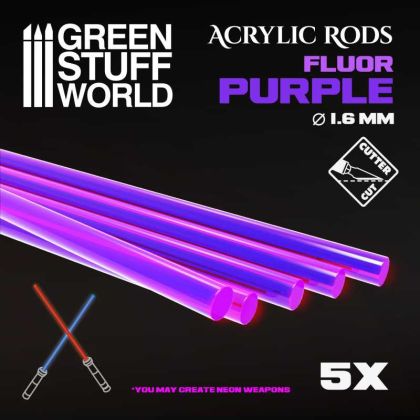
These are transparent acrylic rods with fluorescent colouring. Two diameters are stocked, 1.6 and 2.4 mm, in red-orange, blue, green and violet. Acrylic carries light along its whole length, so the rods become light pipes running from a hidden LED, lit tips, engines and thruster nozzles, energy-blade effects and any other glowing element on fantasy or science-fiction subjects.
The material sands and polishes back to clarity, so a cut end can be made optically clean again.
Two things at once. First it conducts light: put an LED against one end and the whole rod glows, the far end most of all, so a lit feature can sit where no LED would ever fit. Second, the fluorescent colouring means that even with no electronics at all it looks brighter under ordinary light than painted plastic, and under ultraviolet light it glows strongly.
Push the rod into a hole drilled exactly to its diameter, bring the far end up to the LED, and shroud the joint so light does not leak sideways. The smoother the end face, the more light passes, which is why the cut is sanded and then polished. The components for lighting are in the electronics for models.
Fluorescent acrylic is often used with no electronics: on nozzles, discharges, blades and backlit panels. A tip can be sanded to a cone, while a flat end reads as a glowing disc. Mixing several colours on one model works well, provided there is an opaque divider between them.
Acrylic is harder and more brittle than styrene, so it is not sliced through in one pass. Score it around the circumference and snap it, or use a fine saw. The surface clouds after sanding; the clarity comes back with the finest paper and a polish. Bond with cyanoacrylate or an adhesive meant for clear parts, since solvent cement will fog the surface. For other transparent areas, carry on to the styrene and acrylic sheet.
Glowing features earn their keep most on fantasy and science-fiction subjects, so the kits that use them are in the space, sci-fi and fantasy kits.