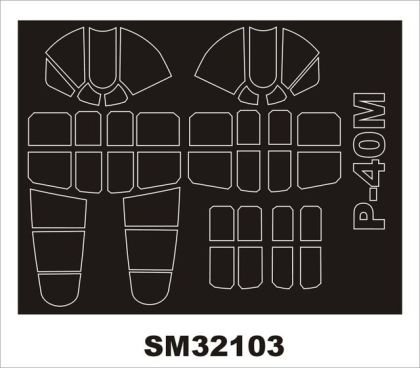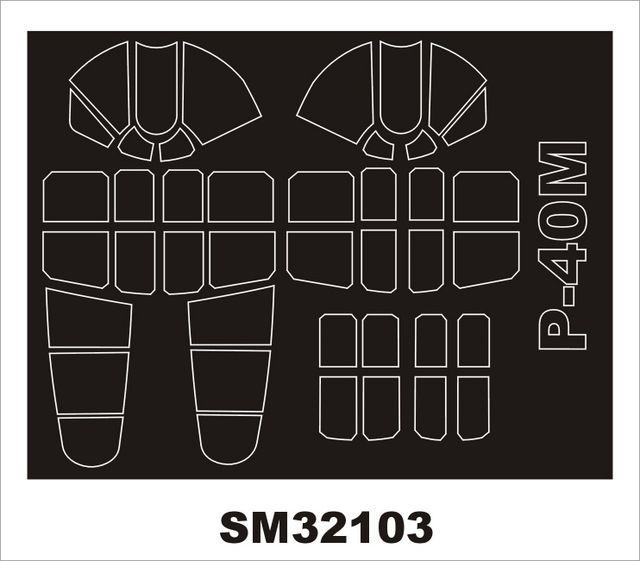
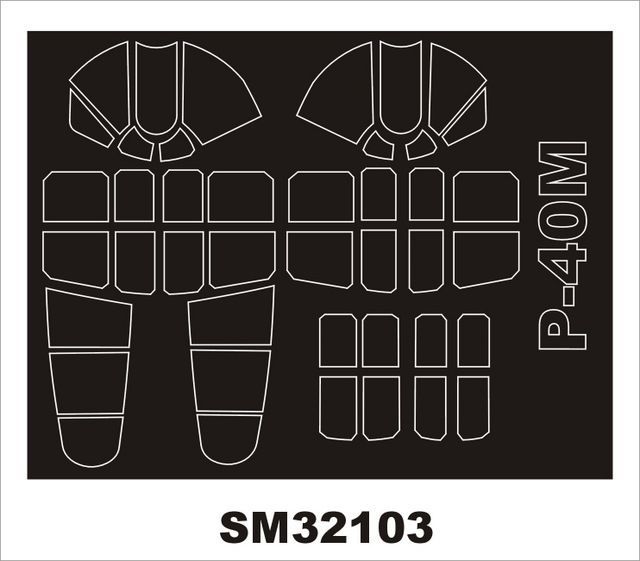
Glazing templates for the Curtiss P-40M in the large 1:32 scale. They are cut for the Hasegawa kit and include shapes for both sides of the sliding canopy and of the fixed cockpit parts.
Responsibility details are not available.
The M version came in 1943 as a late stage of a line the Allies committed on practically every battlefield. It was powered by the Allison V-1710-81 twelve-cylinder with an improved supercharger and you can recognize it on the fuselage behind the exhausts by the lengthened cooling louvers. Most of the machines went from the production line through the Lend-Lease program to the Commonwealth and to Soviet regiments, where they were simply called Kittyhawk. It was no high-altitude fighter, but down low it took a hit another type would not have survived. A robust airframe and good speed in a dive made it a favorite tool for attacks on ground targets.
Even a well-applied film occasionally lets a trace of paint a tenth of a millimeter wide under its edge. In a large scale there is no point sanding the whole area; retouching is faster. Take a brush with one or two hairs, pick up the shade of the glass, that is clear varnish lightly tinted with blue, and go over that hairline alone. The other possibility is the reverse: outline the frame in the frame color and so bring the smeared transition back to a straight edge. Either is a matter of minutes and saves a part that would otherwise go in the bin.
The accessory is sold without the model; the kit itself is a separate product.
Naši poradci a znalci sortimentu jsou připraveni odpovídat na Vaše dotazy (Po–Pá, 8–18 hod).
Zeptejte se na co potřebujete, odpovíme co nejdříve.
Texts from customers in the advice section reflect solely the opinions and views of the customers. MNF trade s.r.o. does not approve or verify customer texts in advance.
There are no questions here yet. Be the first to ask!