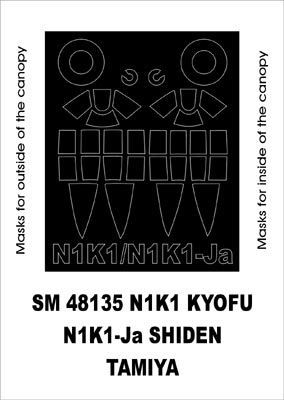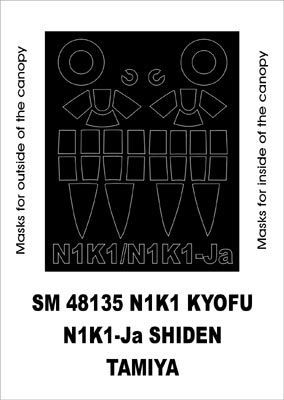
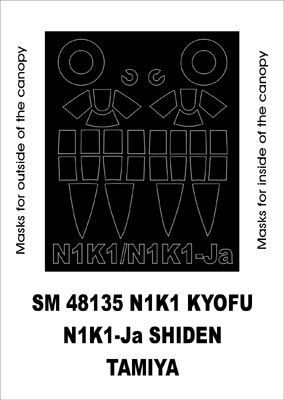
Film with cut shapes for the cockpit glazing of the Japanese floatplane fighter and its land-based successor in 1:48. The covering is dealt with from both sides of the glass and the set is aimed at the Tamiya kit.
Responsibility details are not available.
Kawanishi designed the machine for a situation in which Japanese forces would take an island with no airfield and need to gain air superiority over it at once. The solution was a floatplane fighter able to operate from a lagoon. By the time the aircraft matured in 1943, though, Japan had gone over to the defensive and the commitment it was created for never came. Just under a hundred were built and the Allied designation for it was Rex.
Far more significant was the descendant that grew out of the design. Removing the floats and adding retractable landing gear produced a land-based fighter, but the wing stayed at mid-height on the fuselage, which called for unusually long and troublesome main legs. The aircraft made up for it with automatic combat flaps, which gave it the edge in a turn even over contemporary American fighters. The variant with the Ja index moved all four 20 mm cannon into the wing.
Japanese cockpits of the first half of the 1940s have denser framing than is usual on contemporary European types, and the lines are very narrow besides. Masking such a net by hand reliably ends with one frame coming out wider than its neighbor. Machine-cut parts hold the width the same everywhere and the modeler is left with time for what matters, that is the paint and the shading of the cockpit interior.
Naši poradci a znalci sortimentu jsou připraveni odpovídat na Vaše dotazy (Po–Pá, 8–18 hod).
Zeptejte se na co potřebujete, odpovíme co nejdříve.
Texts from customers in the advice section reflect solely the opinions and views of the customers. MNF trade s.r.o. does not approve or verify customer texts in advance.
There are no questions here yet. Be the first to ask!