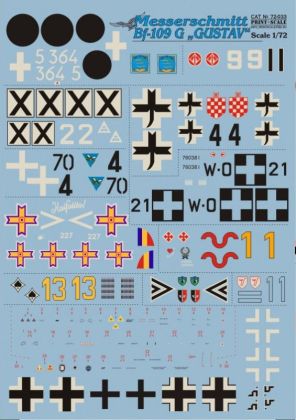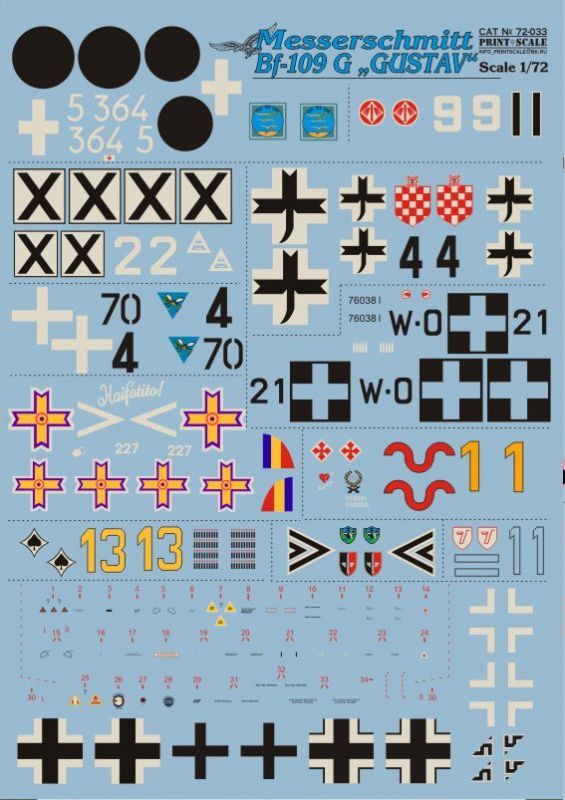
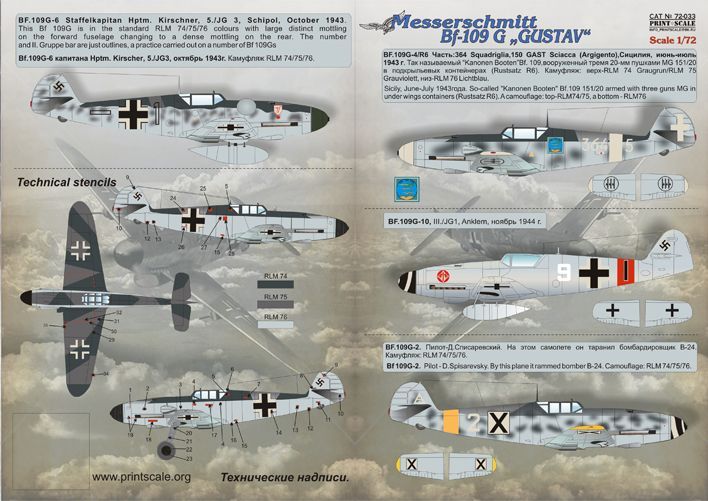
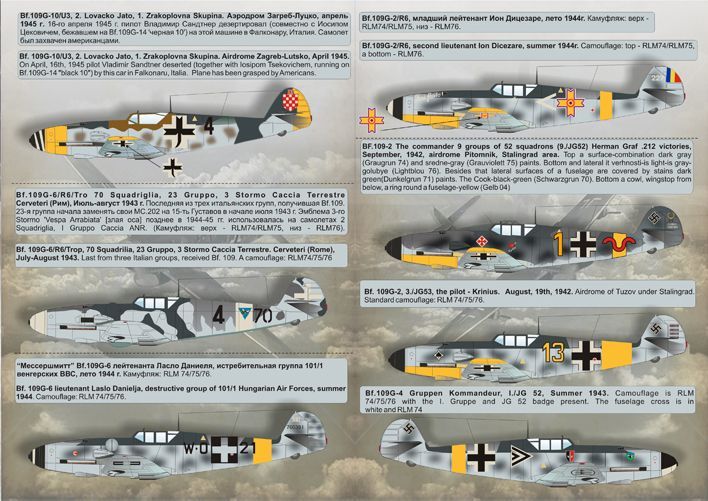
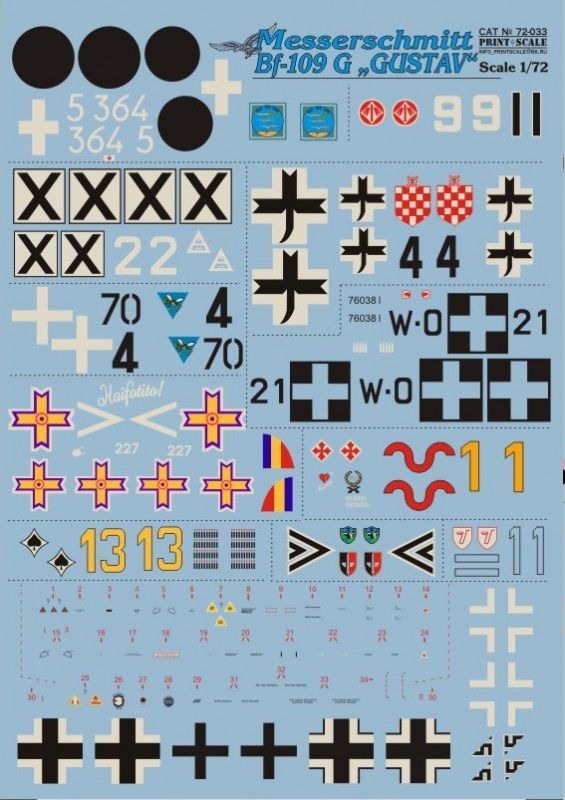
Eleven marking options for the Messerschmitt Bf 109G in 1:72 scale. Beside Luftwaffe machines the sheet also carries Croatian, Hungarian, Romanian, Bulgarian and Italian Gustavs, including the aircraft of the German ace Hermann Graf.
Responsibility details are not available.
The Messerschmitt Bf 109G entered service in 1942 and became the most numerously built version of the whole family. The DB 605 engine brought power but also higher weight, so the Gustav forgave fewer mistakes than the earlier variants. Characteristic features are the bulges over the guns on the nose, which earned it the nickname Beule, meaning bump, and on later examples a tall fin and a wooden rudder.
The sheet reaches beyond the usual German subjects. Besides a Sicilian machine with underwing cannon gondolas to the R6 kit, it offers a Gustav of a Croatian fighter group from Zagreb-Lutsko airfield in the spring of 1945, an Italian example of the 23° Gruppo at Cerveteri, a Hungarian aircraft of Lieutenant Daniel, a Romanian machine of Second Lieutenant Dicezare and the Bulgarian aircraft of the pilot who rammed a B-24 bomber.
What to watch out for:
Anyone building a series of Gustavs will appreciate that a single sheet covers several countries at once. A Bf 109G kit of the matching sub-version in 1:72 scale is needed for the model.
The color side of this type is rewarding. Mediterranean examples carried a lighter upper finish with sand mottling, while aircraft over the Balkans and over the Reich stayed with the darker gray-green combination. How much work the base under the markings takes therefore differs with the option you pick.
Naši poradci a znalci sortimentu jsou připraveni odpovídat na Vaše dotazy (Po–Pá, 8–18 hod).
Zeptejte se na co potřebujete, odpovíme co nejdříve.
Texts from customers in the advice section reflect solely the opinions and views of the customers. MNF trade s.r.o. does not approve or verify customer texts in advance.
There are no questions here yet. Be the first to ask!