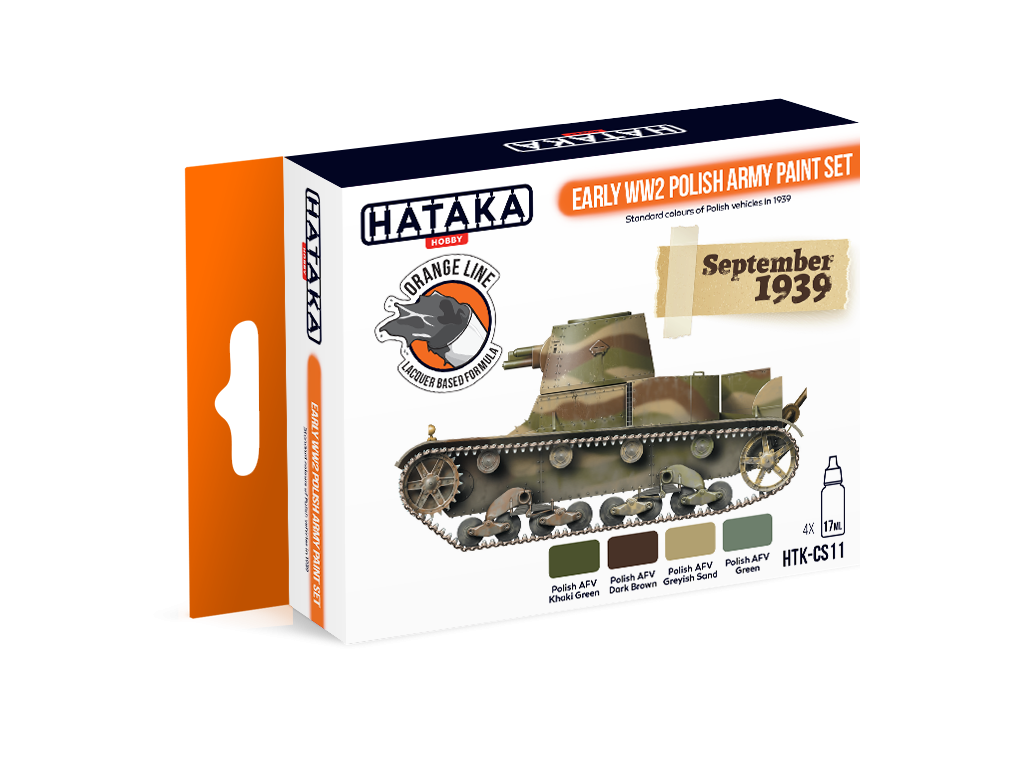
Four shades for the ground vehicles of the Polish army of 1936 to 1939: khaki green, grayish sand, dark brown and the green of the three-color scheme.
Responsibility details are not available.
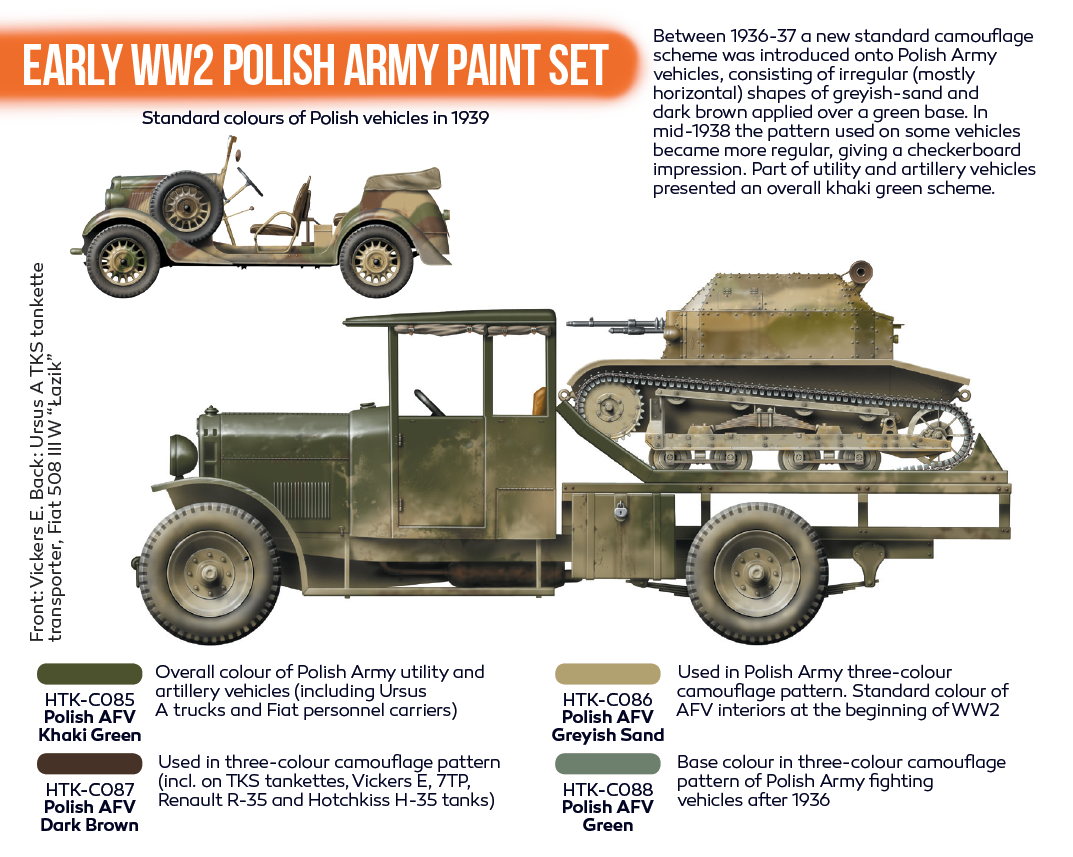
These four bottles are aimed at the equipment of the Polish army of the last prewar years and of the September campaign. The make-up is entirely a ground one: from artillery tractors and trucks through tankettes to the light tanks the army put into action in 1939.
The base tone is khaki green, with which utility and artillery vehicles were painted in a single-color finish, among them Ursus A trucks and Fiat armored personnel carriers. The grayish sand had a double role: it made up one of the components of the three-color camouflage and was at the same time the standard shade of the interiors of combat vehicles at the start of the war. The dark brown gives the same pattern its darkest patches and appears on TKS tankettes, on the Vickers E and 7TP tanks and on the Renault R-35 and Hotchkiss H-35 machines that reached the Polish inventory from abroad. The last bottle holds the green that after 1936 was the base tone of the three-color scheme of combat vehicles.
Tuning the Polish three-color camouflage from individually bought paints is slow, because the shades have to relate to one another. Here they are together and mix with one another, so lighter transitions can be worked out from them to suggest fading, dust and sun bleaching.
Degrease the parts, let the primer dry thoroughly and thin the paint with the product the manufacturer gives for this range. Richness comes from repeated thin passes, not from one heavy coat.
Naši poradci a znalci sortimentu jsou připraveni odpovídat na Vaše dotazy (Po–Pá, 8–18 hod).
Zeptejte se na co potřebujete, odpovíme co nejdříve.
Texts from customers in the advice section reflect solely the opinions and views of the customers. MNF trade s.r.o. does not approve or verify customer texts in advance.
There are no questions here yet. Be the first to ask!