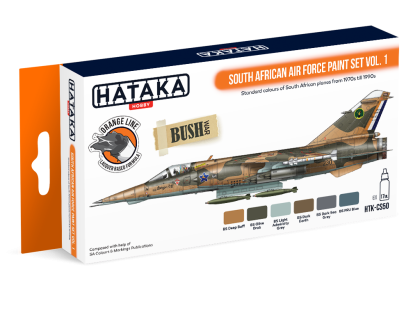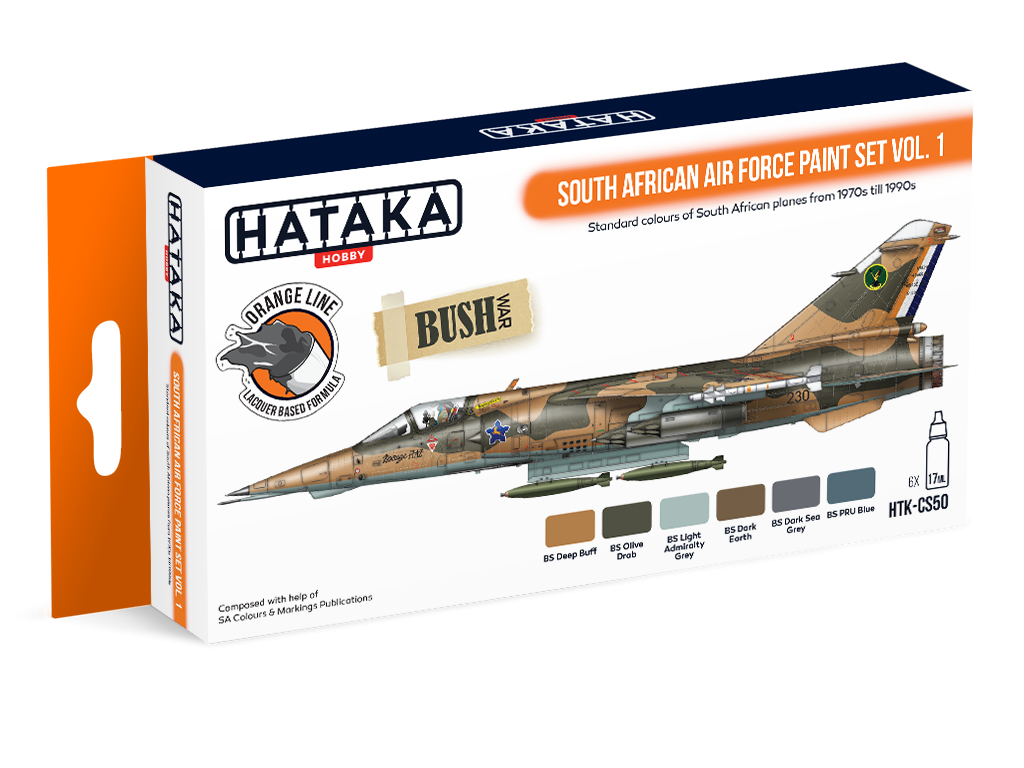
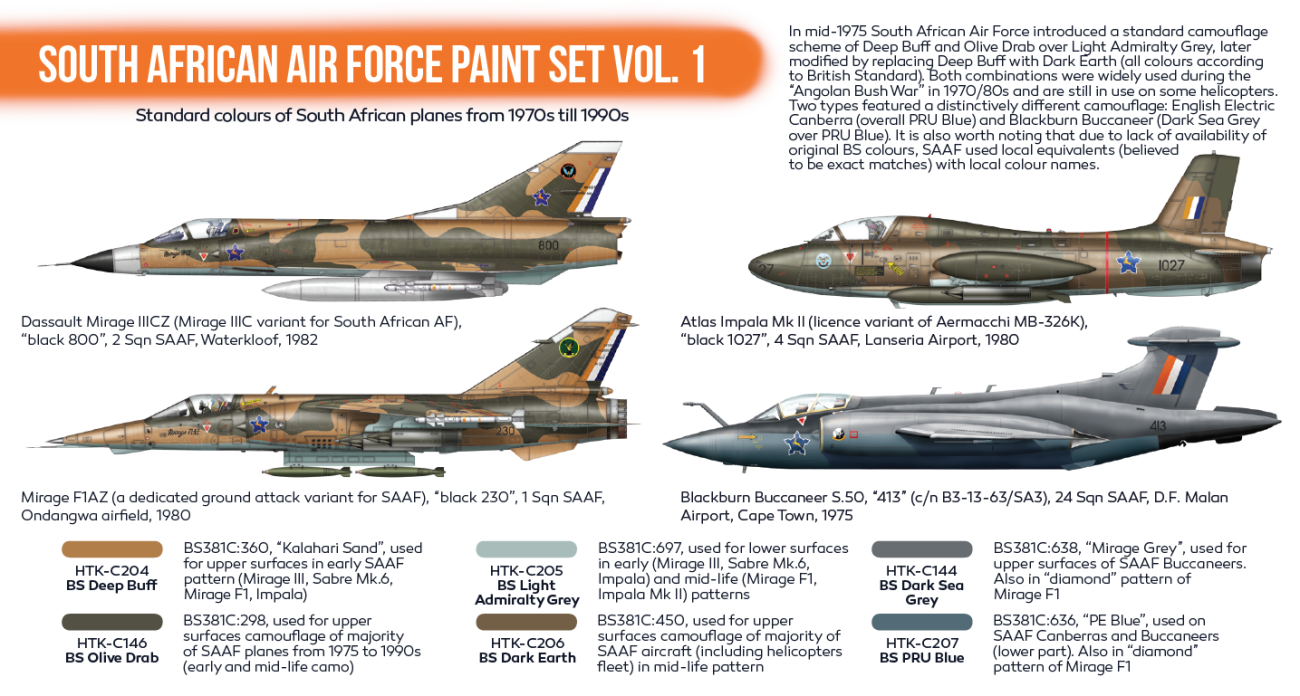
Six lacquer shades to the British BS 381C standard, put together for the aircraft of the South African Air Force. It includes desert and olive upper layers, two grays for the lower surfaces and a blue for reconnaissance and bomber machines.
Responsibility details are not available.
In the 1970s and 1980s the South African Air Force built up a color world of its own. Because of an international embargo it could not renew its equipment, so it stayed with the machines it had and adapted them carefully to the terrain. That gave rise to schemes derived from the British BS 381C standard, in which desert sand and olive alternate according to the ground that was flown over. The early version with a sand-colored top was worn by Mirage III, Sabre Mk.6 and the home-built Impala, the later richer schemes by the Mirage F1 and the helicopter component. The Buccaneers and Canberras were a chapter of their own, as they received gray and blue coats.
The range is a lacquer one, so it is thinned with solvent and dries to a hard matte coat. For this type of camouflage that is an advantage: the transitions between the fields were sprayed fairly crisply on South African machines, and a lacquer base holds the edge even without a mask, provided you work from a short distance and at low pressure.
Desert tones quickly fade into one uniform area on a model. It helps to brighten the upper field slightly later with a drop of white and, the other way round, to underline the shadows with the darker earth tone.
Naši poradci a znalci sortimentu jsou připraveni odpovídat na Vaše dotazy (Po–Pá, 8–18 hod).
Zeptejte se na co potřebujete, odpovíme co nejdříve.
Texts from customers in the advice section reflect solely the opinions and views of the customers. MNF trade s.r.o. does not approve or verify customer texts in advance.
There are no questions here yet. Be the first to ask!