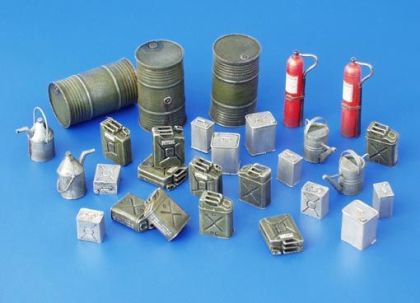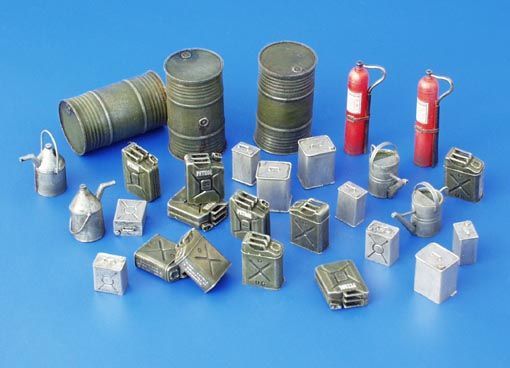
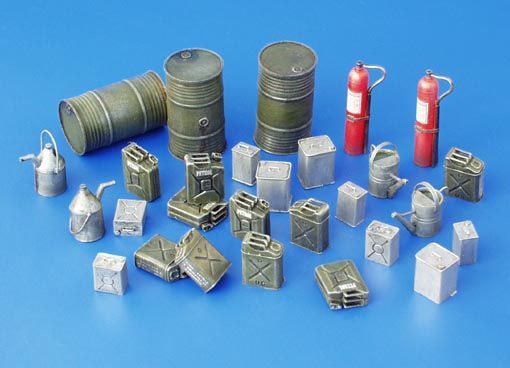
Fittings of an Allied fuel depot in 1:35: resin castings, a decal and photo-etched parts.
Responsibility details are not available.
Supplying gasoline set the Western Allies apart more than it seems at first glance. The British relied at first on thin-walled four-gallon tins, which split open on the way across the desert and let the supply run literally into the sand. The Americans used a square can with a single handle and a screw cap, while the can with three handles and a hinged lever was adopted by both armies only later, following the German pattern. In a depot, therefore, containers of several shapes met side by side.
Beside the cans stood steel drums, which were filled straight from tankers. They carried colored stripes and stenciled lettering giving the type of fuel, because mixing up gasoline and diesel could put a whole column out of action. It is precisely this chaos of markings that makes a depot an interesting diorama motif: uniform rows of containers look untrue, whereas a mixture of battered and new pieces does not.
Cans and drums wear along the edges and on the bottom, far more than on the sides. The paint comes off in the places where they are thrown about from a truck bed, and the area around the cap tends to be spattered from pouring. Rust clings in dents and seams, not in continuous areas.
The decal makes it possible to mark the fuel designation without drawing. Before applying it, paint the area to a gloss, otherwise silvery edges will appear under the film. The photo-etched parts will serve as handles, loops and small pumping details that cannot be drawn out of castings in such fineness.
Naši poradci a znalci sortimentu jsou připraveni odpovídat na Vaše dotazy (Po–Pá, 8–18 hod).
Zeptejte se na co potřebujete, odpovíme co nejdříve.
Texts from customers in the advice section reflect solely the opinions and views of the customers. MNF trade s.r.o. does not approve or verify customer texts in advance.
There are no questions here yet. Be the first to ask!