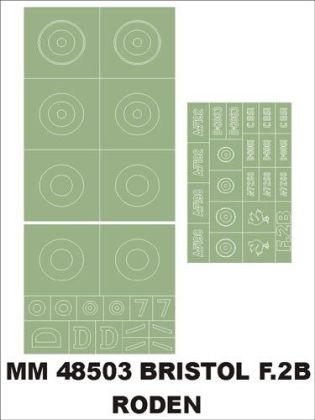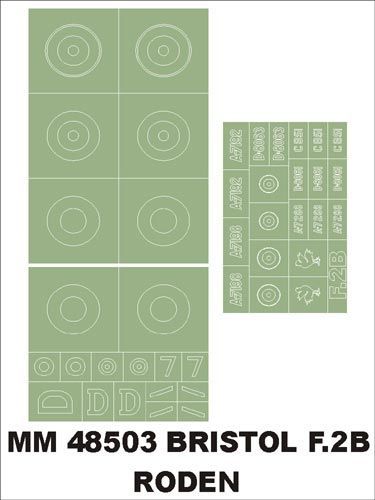
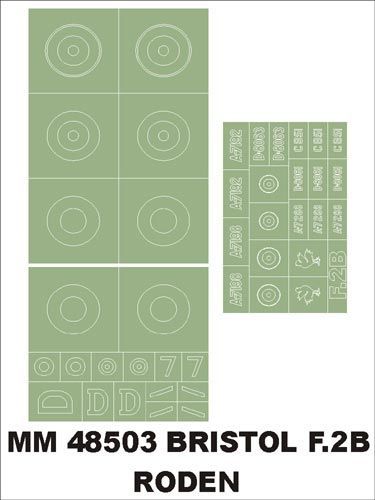
Insignia masks for the British two-seat combat aircraft. The roundels for the upper and the lower wing surface are applied by spraying.
Responsibility details are not available.
The Bristol F.2B came about as a reconnaissance and observation aircraft with a pilot and a gunner, but the crews soon found that it could attack as fiercely as a single-seat fighter. A strong engine, a sturdy structure and two fields of fire made it a type opponents kept away from. It stayed in service for an exceptionally long time, with some units for a good decade after the fighting ended.
Here the roundel sits on the upper as well as the lower surface of the flying surfaces, and at the span of the subject it takes up a substantial part of the wing chord. That has a practical consequence: the marking often touches the edge of an aileron or runs across the joint between parts. A decal will not lie over a break like that without a wrinkle, whereas sprayed paint follows the shape perfectly and does not bridge the joint. In 1:48 the difference shows even without a magnifier, which is the main reason masks are worth it on biplanes.
Recommended procedure: treat the area with varnish, let it cure overnight and lay the mask only on a completely dry surface. It is good to run a wooden stick along the edges so that the film seats over a rib as well. Keep the spraying light and repeat it rather than laying it on heavily; one heavy coat builds a ridge at the edge that stays palpable once the mask is off.
Naši poradci a znalci sortimentu jsou připraveni odpovídat na Vaše dotazy (Po–Pá, 8–18 hod).
Zeptejte se na co potřebujete, odpovíme co nejdříve.
Texts from customers in the advice section reflect solely the opinions and views of the customers. MNF trade s.r.o. does not approve or verify customer texts in advance.
There are no questions here yet. Be the first to ask!