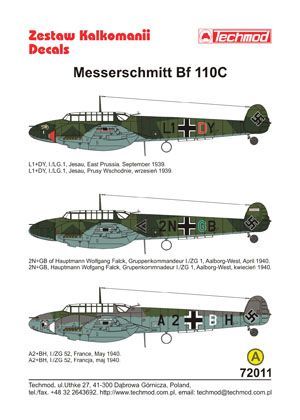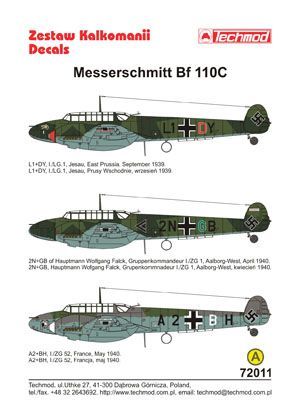
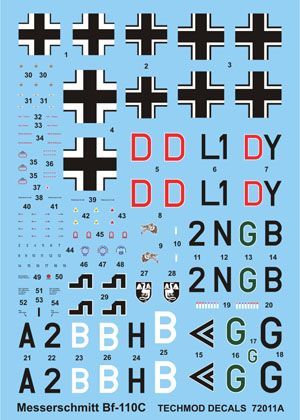
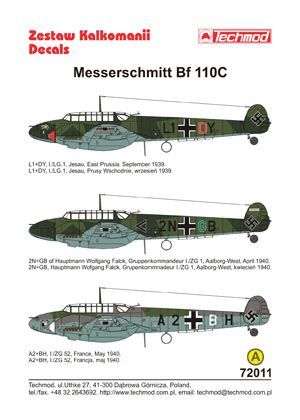
A set of markings for the heavy fighter Messerschmitt Bf 110C in 1:72. Three schemes cover the period from September 1939 to the spring of 1940 and among them is the aircraft of Wolfgang Falck.
Responsibility details are not available.
According to the original idea the twin-engine Bf 110 was to force a path for the bombers deep into enemy airspace. The C subversion was the first truly production one and carried a pair of Daimler-Benz 601 series engines, four machine guns and two cannons in the nose and a flexible gun for the radio operator at the rear. Over Poland and Scandinavia it did convincingly; only over southern England did it run into more agile single-engine opponents. The experience from precisely these machines later led to the rebuilding of the type into a night fighter.
The German system of fuselage markings is read in two parts: the two characters before the cross belong to the formation, the character after the cross then to the machine and the flight. The trio on the sheet therefore covers three different formations and three different theaters, from the opening campaign through the occupation of Denmark to the campaign in the west. Anyone building several examples of the same type gets a whole half-year of development in one package.
The fuselage codes are printed including the color distinction of the Staffel, which with this type tends to be the most laborious part of the build. The base under the markings has to be smooth and glossy; on a rough matte finish air will stay under the film and the edge will whiten. Once dry, the surplus adhesive is wiped off with a damp cloth. The package holds the sheet only, not parts of a model.
Naši poradci a znalci sortimentu jsou připraveni odpovídat na Vaše dotazy (Po–Pá, 8–18 hod).
Zeptejte se na co potřebujete, odpovíme co nejdříve.
Texts from customers in the advice section reflect solely the opinions and views of the customers. MNF trade s.r.o. does not approve or verify customer texts in advance.
There are no questions here yet. Be the first to ask!