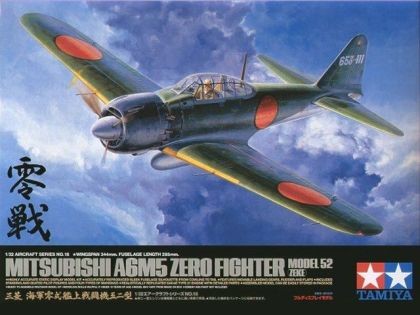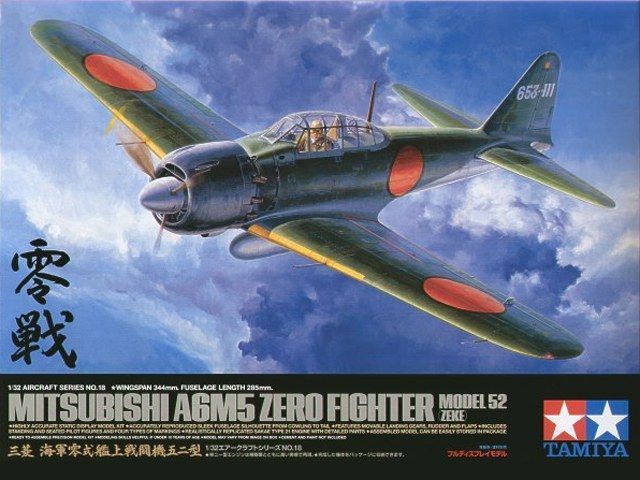
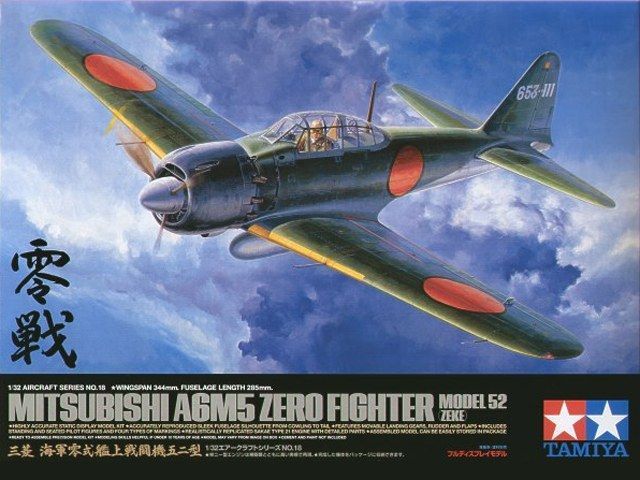
Mitsubishi A6M5 Zero Fighter Model 52 (Zeke) in 1:32 from Tamiya - a large-scale plastic kit of the most widespread version of the Japanese carrier fighter. The package contains a detailed Sakae engine, photo-etch, metal cannon barrels, masks and four marking options.
Responsibility details are not available.
The flagship large-scale kit of the Japanese carrier fighter Mitsubishi A6M5 Zero Model 52 in 1:32 from the firm Tamiya. The model is marked out by a richly worked Nakajima Sakae type 21 radial engine and a detailed cockpit interior. The landing gear, the rudder, the elevators and the flaps are movable; the engine cowlings and the canopy can be built open or closed. The package includes metal parts, the barrels of the 20 mm cannon and the pitot tube, and photo-etch, for example the screens of the intakes and the harness straps. The machine gun barrels are painted in advance. Enclosed are masks for the glazing, two pilot figures (seated and standing) with clear parts for the goggles, a stand for displaying the aircraft in flight and four marking options. The drop tank and the propeller can be taken off once the model is built, so that the finished model fits back into the box. The finished model is 285 mm long with a span of 344 mm.
The A6M Zero was the carrier fighter of the Imperial Japanese Navy and in the first years of the war in the Pacific ranked among the most feared machines of its class; it excelled in agility and in exceptional range, for which it paid with weak armor protection. Model 52 became the most produced version of the whole family. Compared with the earlier machines it received shortened wings with rounded tips without folding ends and individual exhaust stacks, whose thrust raised the speed. It was powered by the Nakajima Sakae radial engine. The Allied code name of the aircraft was Zeke. Japan put Model 52 into service from 1943 and it fought until the end of the war.
Finish and paint the cockpit and the engine before you close the fuselage and the cowlings, because afterwards there is no getting to them. Glue the photo-etched screens and straps with cyanoacrylate and the plastic with a thin cement for plastic. Apply a primer before spraying and mask the glazing with the masks enclosed. The engine deserves time: a base of dark metal paint, then dry brushing and a mild wash into the recesses. Apply the decals onto gloss varnish, so that no white film forms around them, and give the finished model a matte coat; Japanese naval machines tended to be weathered, so a fine scuffing of the finish on the walkway areas of the wing suggests itself as well.
The model is supplied unassembled and unpainted. Glue, paints and accessories are not included in the package, unless stated otherwise.
Naši poradci a znalci sortimentu jsou připraveni odpovídat na Vaše dotazy (Po–Pá, 8–18 hod).
Zeptejte se na co potřebujete, odpovíme co nejdříve.
Texts from customers in the advice section reflect solely the opinions and views of the customers. MNF trade s.r.o. does not approve or verify customer texts in advance.
There are no questions here yet. Be the first to ask!