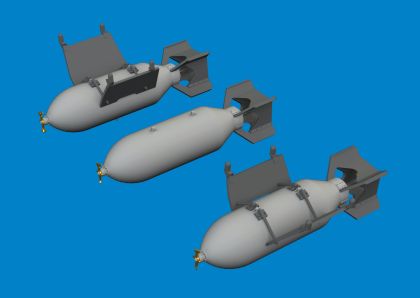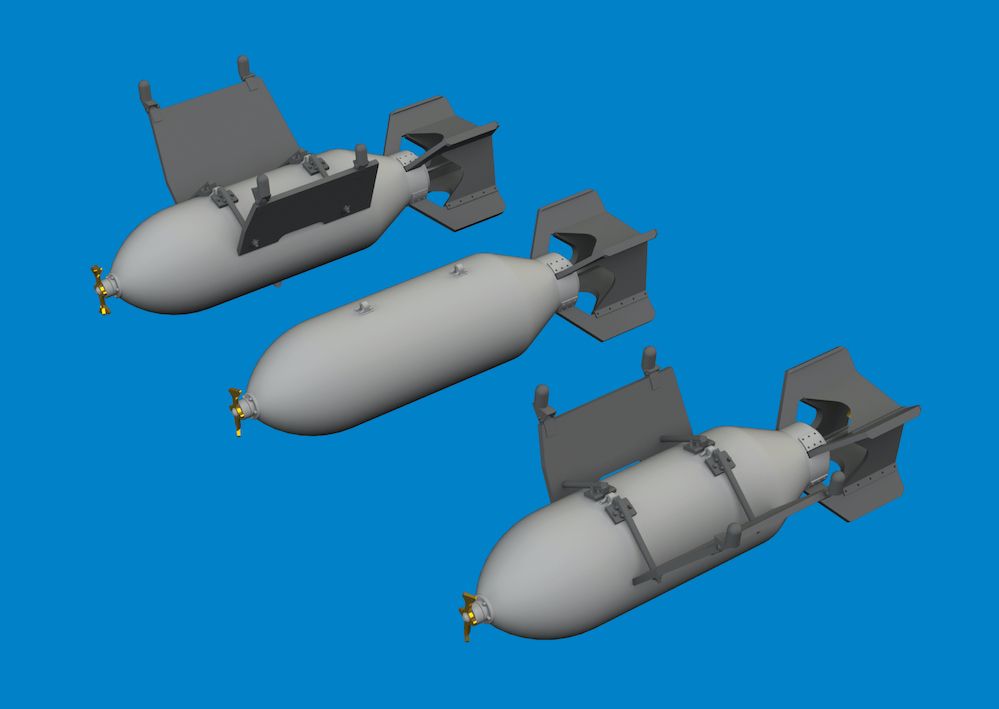
A set of American 500-pound M64 bombs for the Curtiss P-40E Warhawk in 1:48.
Responsibility details are not available.
The designation M64 belonged to the 500-pound general-purpose bomb that formed the backbone of American aerial armament from North Africa to the Pacific. It carried roughly half its own weight in explosive, had a sheet-metal fin assembly and an arming vane on the nose whose fuze was only armed by the airflow after release. The Warhawk hung it on the pylon under the fuselage when squadrons turned it into a fighter-bomber.
Bombs in kits tend to be split into two halves, so after gluing there is a seam around the whole body that has to be sanded across the engraving of the bands. Here that falls away: the body comes in one piece, the tail assembly has the right thinness and the surface carries fine riveting and the lugs.
The parts are separated from the gate with a saw or a cutter, never by snapping. What is left of the gate only needs leveling with abrasive paper and going over the surface with a primer. The color markings of bombs matter a great deal for credibility: a yellow band at the nose meant a filled charge, while the body itself was usually in an olive or a gray shade depending on the year of manufacture.
Anyone building an airfield scene can leave the ordnance lying on a trolley beside the aircraft. Armorers moved them one at a time, and handling them was a rewarding subject for period photographs, so a pair of figures at the trolley will give the scene some action without much extra work.
Naši poradci a znalci sortimentu jsou připraveni odpovídat na Vaše dotazy (Po–Pá, 8–18 hod).
Zeptejte se na co potřebujete, odpovíme co nejdříve.
Texts from customers in the advice section reflect solely the opinions and views of the customers. MNF trade s.r.o. does not approve or verify customer texts in advance.
There are no questions here yet. Be the first to ask!