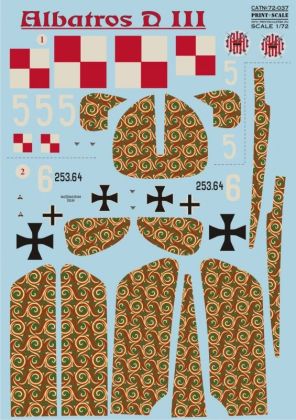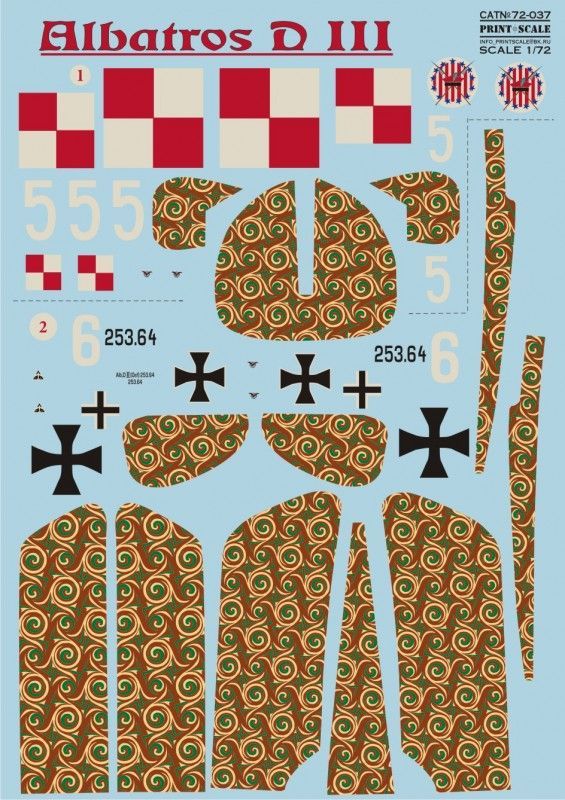
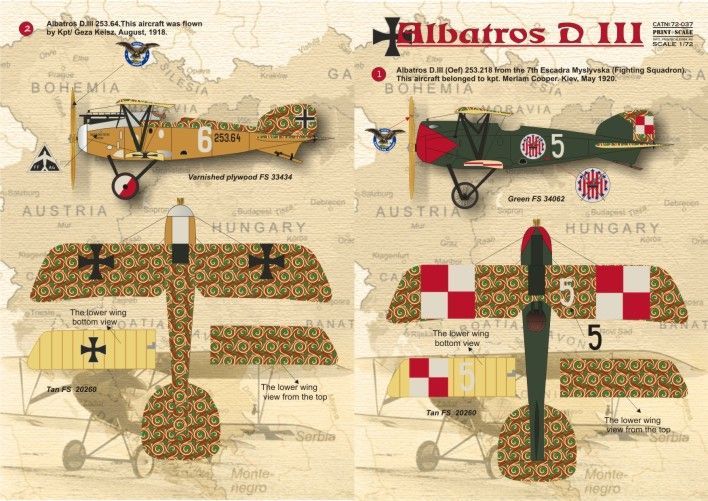
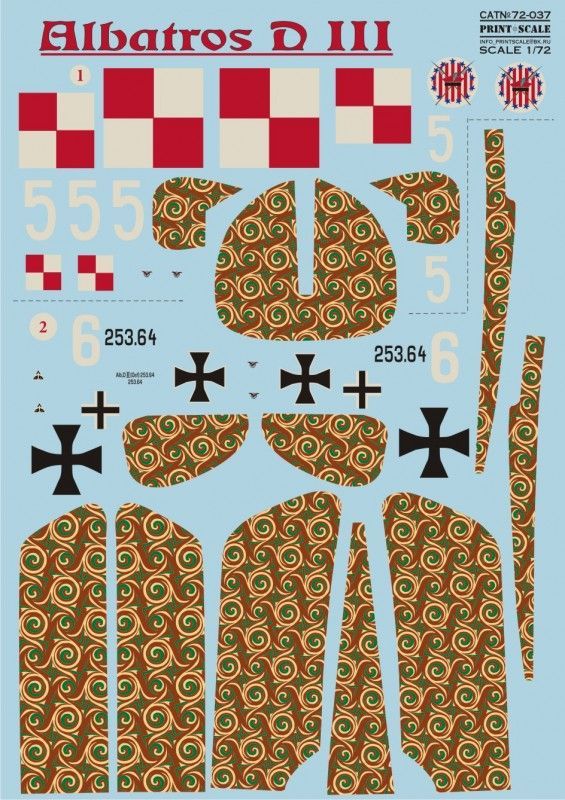
Two marking options for the Albatros D.III biplane in 1:72 scale. One subject is an Austro-Hungarian machine from the summer of 1918, the other an aircraft of the Polish 7th Fighter Escadrille from the war of 1920.
Responsibility details are not available.
The Albatros D.III came about by combining the slender plywood fuselage of the earlier Albatros machines with a lower wing of smaller chord and a single V-shaped interplane strut. The layout improved the view downwards and the agility, but it was paid for by a weaker attachment that cracked in a sharp dive. Even so it was this type that bore the main weight of the fighting over the Western Front in the spring of 1917 and became a symbol of the period when German fighter units gained the upper hand.
License production at the Oeffag works in Vienna gave the type a second life. The Austrian machines of the 253 series received a more powerful Austro-Daimler engine and a rounded nose with no spinner, were stronger and were flown long after 1918. It is from there that both subjects on the sheet come: the machine of Captain Keisz from August 1918 and the aircraft flown two years later by the 7th Escadrille with American volunteers in the service of the newly formed Polish Air Force.
Practical notes for the build:
Both subjects also serve as a way into a less usual theme: the aviation of central Europe shortly after the First World War, when old machines served new states. The package contains a printed sheet; the plastic model of the biplane in 1:72 scale has to be obtained separately.
Naši poradci a znalci sortimentu jsou připraveni odpovídat na Vaše dotazy (Po–Pá, 8–18 hod).
Zeptejte se na co potřebujete, odpovíme co nejdříve.
Texts from customers in the advice section reflect solely the opinions and views of the customers. MNF trade s.r.o. does not approve or verify customer texts in advance.
There are no questions here yet. Be the first to ask!