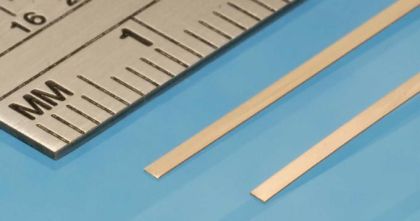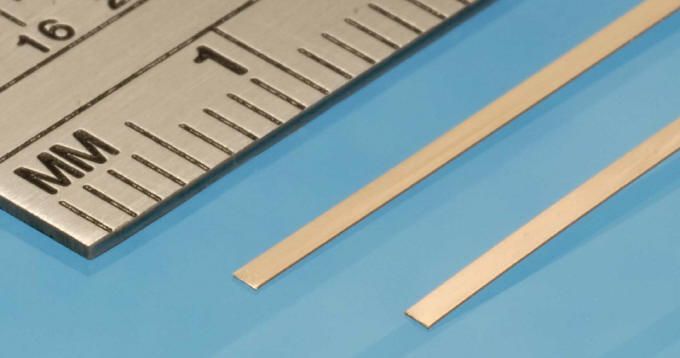
A brass strip 25 mm wide and 0.4 mm thick in a length of 305 mm, the widest of the thin formats in the range.
Responsibility details are not available.
Twenty-five millimeters wide, four tenths thick and 305 mm long. In practice this is not flat bar but rather a narrow sheet from a coil straightened into a flat strip. It is the width that changes the way the material is worked: instead of a ready-made profile you get an area out of which you cut the shapes yourself.
Fenders and their edges, cargo bed side panels, sheet metal covers, add-on armor plates, floors and ramps, tank hatches, roof edging, signs and boards. The width is even enough for three separate narrow strips to be cut from one piece when a slimmer size happens to be missing from the drawer. The surface can be textured: a riveting wheel produces rows of rivets, a blunt needle suggests swages, and a frame tapped in from behind creates raised ribs.
Straight cuts are made by a knife against a steel ruler, repeatedly and without pressure, until the groove lets the sheet be snapped. Internal cutouts are work for a drill and a needle file. Wide thin sheet likes to ripple, so back it with a hard board while working. A curve comes from winding it around round stock, and a sharp bend from clamping it between two straight steel edges.
Brass is greasy from manufacture to begin with. A short bath in degreaser and a pass with a scouring pad decides whether the primer stays on or peels away in whole sheets once dry.
Offcuts from the edges come in useful for small hardware and clasps, so once the main part is cut out, one piece still leaves a reserve for several kits ahead.
Naši poradci a znalci sortimentu jsou připraveni odpovídat na Vaše dotazy (Po–Pá, 8–18 hod).
Zeptejte se na co potřebujete, odpovíme co nejdříve.
Texts from customers in the advice section reflect solely the opinions and views of the customers. MNF trade s.r.o. does not approve or verify customer texts in advance.
There are no questions here yet. Be the first to ask!