A compressor is the part of an airbrush setup nobody sees on the finished model and everybody sees in the paint. Stable pressure means a flat, even panel with no craters and no pulsing. This section covers small diaphragm units built for modelling work, versions with a tank, and quieter designs intended for a flat rather than a workshop.
The specifications that matter are not the ones printed largest on the box. Below we explain the pressures modelling actually uses, why a water trap is not an accessory, and what automatic shut-off changes on a long session.
A modeller needs calm and consistency rather than output. Spraying pressure usually sits between 1 and 2.5 bar, which is roughly 15 to 36 psi, depending on how far the paint is thinned and how large the nozzle is. A small diaphragm unit manages that comfortably. What matters is that the pressure can be set and that it does not drift while you are spraying.
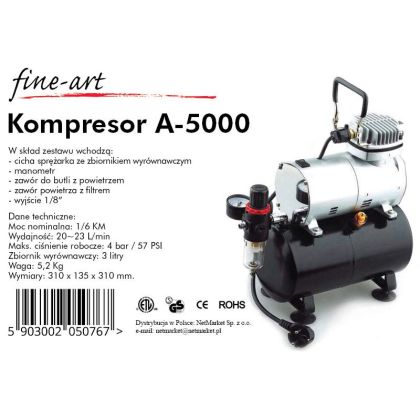
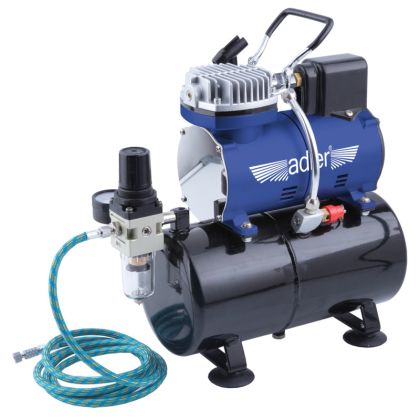
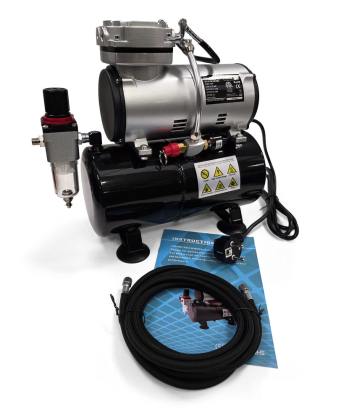
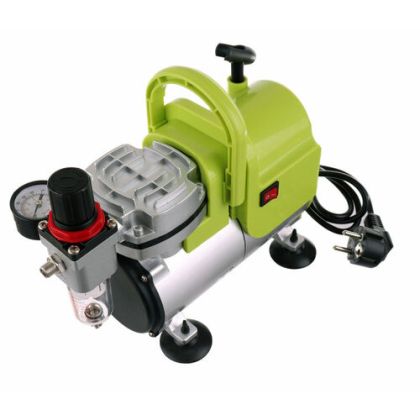
Without a regulator you spray at whatever the compressor produces and have to thin the paint to suit the machine. A gauge lets you return exactly to the setting that worked last time, which is worth more than it sounds once you start keeping notes. Combined regulator and gauge units are commonly mounted on the compressor itself.
The air a compressor draws in carries moisture, and compression condenses it. One drop of water in the hose lands on the model as a crater in fresh paint. A trap catches it and you drain it through a valve; on a long session, check it between colours rather than at the end.
A tankless compressor pushes air straight into the hose, so the pattern can pulse slightly. A tank evens the pressure out and also lets the motor stop once working pressure is reached and restart only when it drops. The result is quieter running and less heat, which is what you notice during a long evening over a large model.
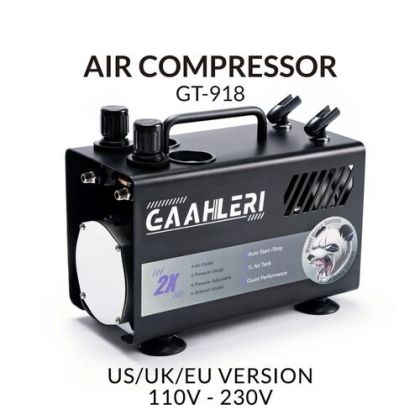
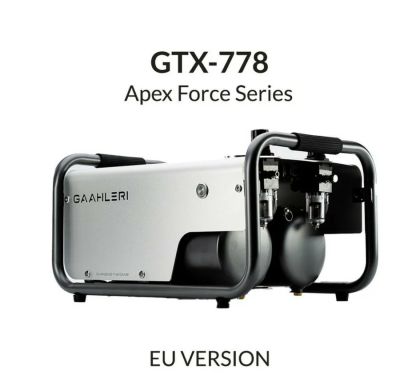
If you paint in a flat, deal with noise before output. On connections, check the thread and the type of quick coupler so your existing hose fits. Adapters and hoses are in spare parts and accessories.
Try the settings on scrap plastic before the model. Pressure, thinning and distance behave as one system, and changing any of the three shows up in the finish. The rest of the setup is under airbrush equipment.