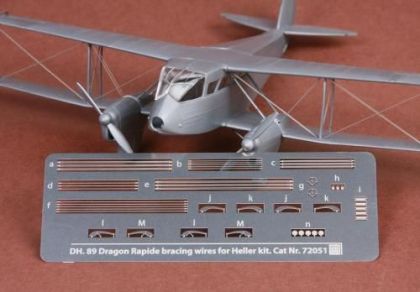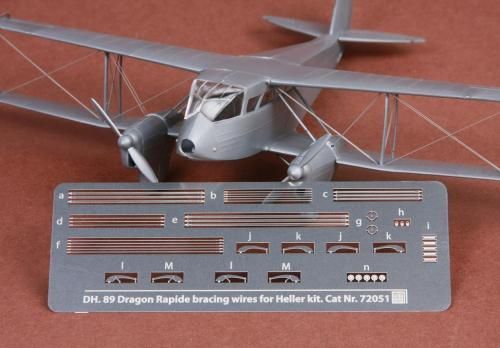
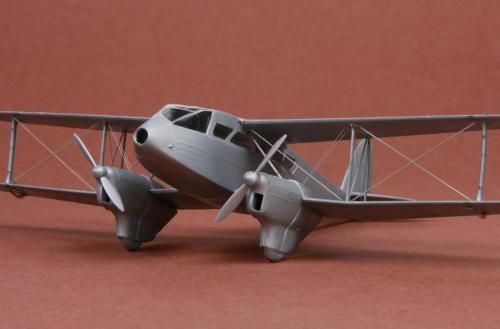
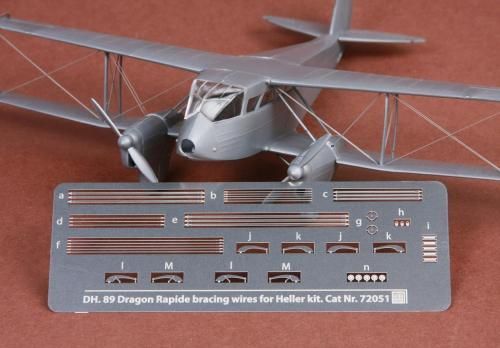
A set of metal bracing wires for a de Havilland DH-89 Dragon Rapide model in 1:72 scale. It completes the interplane gap with exact elements instead of stretched line.
Responsibility details are not available.
The de Havilland DH-89 Dragon Rapide was a British twin-engine biplane of the 1930s, built mostly of wood and fabric. It carried passengers on short routes, served as an air taxi and in altered roles flew on long after the Second World War. The narrowed lower wing, the elegant tail of the fuselage and the system of bracing wires between the flying surfaces make it a rewarding subject for a model.
Elements for rigging a Dragon Rapide model in 1:72 scale. The metal parts have a constant thickness along their whole length, so the bracing looks convincing in a small scale and will not sag with time. They are released from the fret with a sharp blade laid a little away from the part, and the remaining stub is sanded down.
Leave the rigging until the end, when the model is varnished and the paint has dried. Drill the anchor points in the wings with the finest drill you have, and do it before the wings are glued to the fuselage. Shorten the elements in small steps and try them dry, because material can always be taken off and never put back. Dose the cyanoacrylate with the tip of a toothpick, otherwise a glossy blob stays at the anchor point that no clear coat will cover.
The set is for modelers who want the interplane gap finished in detail and do not want to rely on monofilament or on stretched sprue. The work is slow, but it takes no special skill, only a sharp blade, tweezers and a steady hand. The kit, paints and glue are not part of the delivery, unless stated otherwise.
Naši poradci a znalci sortimentu jsou připraveni odpovídat na Vaše dotazy (Po–Pá, 8–18 hod).
Zeptejte se na co potřebujete, odpovíme co nejdříve.
Texts from customers in the advice section reflect solely the opinions and views of the customers. MNF trade s.r.o. does not approve or verify customer texts in advance.
There are no questions here yet. Be the first to ask!