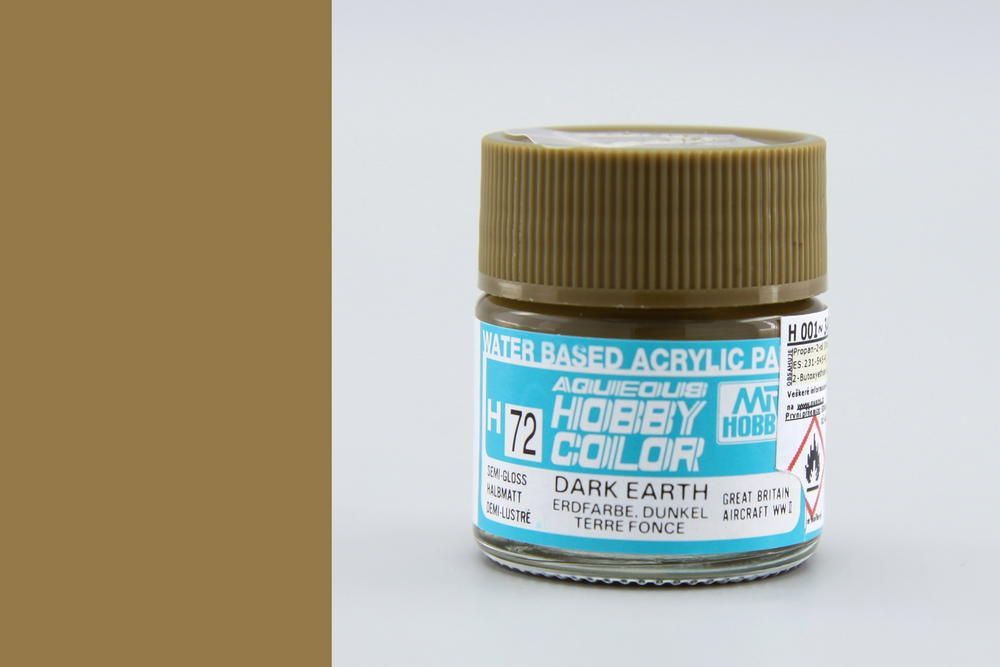

A modeling acrylic on a water base in a small glass jar. The dark earth, together with the green, forms the upper pair of the British camouflage from the time of the Battle of Britain.
Responsibility details are not available.
The pair of dark earth and dark green formed the standard upper scheme of British single-engined fighters and bombers from the second half of the 1930s. The Hurricanes and Spitfires that climbed over the airfields of southern England in the summer of 1940 carried exactly this brown component, at first in the so-called Pattern A and in its mirror counterpart B, which was assigned to aircraft according to the serial number of the airframe.
The same tone holds on desert aircraft too, where a lighter stone shade was used instead of the green, and on training types with prominent yellow areas. The brown is therefore among the bottles most often reached for by anyone building British aircraft of the first half of the war. Period photographs also show how strongly the brown grayed as it faded in the sun, so two aircraft of one squadron could look quite different.
The soft transition between the two upper colors is best imitated with a mask of modeling putty laid loosely and lifted about two millimeters above the surface. Anyone painting with a brush lays on two thin coats so that the engraving and the riveting stay legible.
Once dry, it is a good idea to even the area out with a light matte varnish and only then lay the decals, otherwise silvery edges will appear under their film. Only at the very end does the whole airframe get its matte finish.
Naši poradci a znalci sortimentu jsou připraveni odpovídat na Vaše dotazy (Po–Pá, 8–18 hod).
Zeptejte se na co potřebujete, odpovíme co nejdříve.
Texts from customers in the advice section reflect solely the opinions and views of the customers. MNF trade s.r.o. does not approve or verify customer texts in advance.
There are no questions here yet. Be the first to ask!