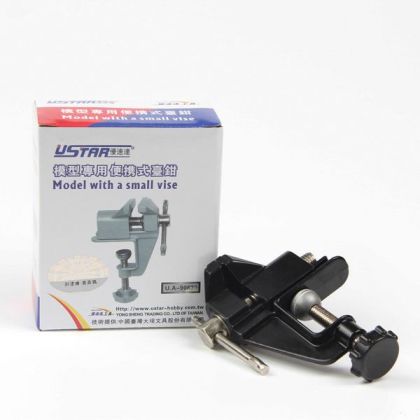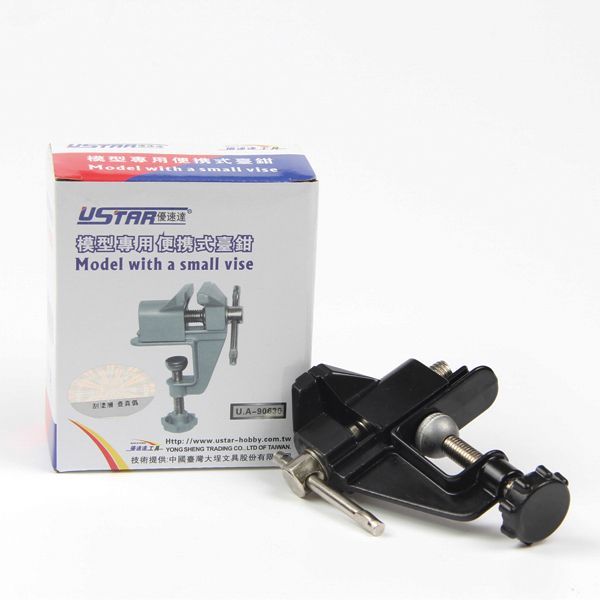
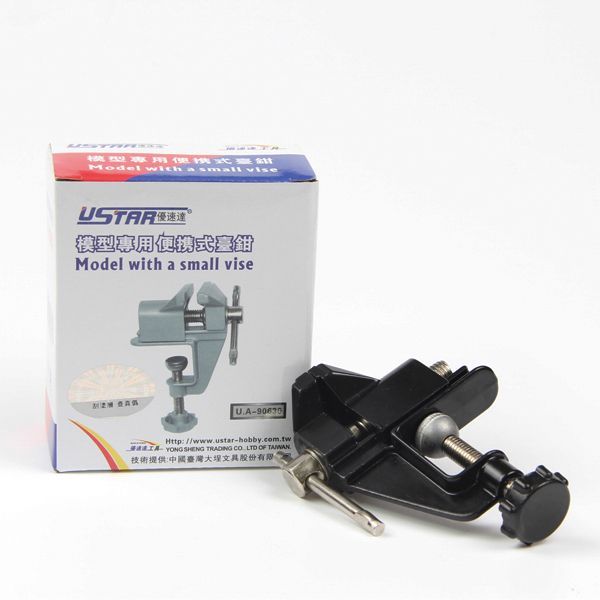
The smaller form of a modeling vise, a width of 40 mm and jaws that open to 30 mm.
Responsibility details are not available.
Not every operation calls for robust tools. When you are fitting an etched part, sanding the end of a metal tube or looking for the right angle on a small resin casting, a large vise gets in the way rather than helping. This piece is narrower than its bigger brother, its jaws are 40 mm wide and they open to 30 mm.
The smaller size has two advantages that are often forgotten. A shorter arm means the lever of the tightening screw will not develop as much force, and a thin walled casting therefore survives more easily. And because it takes up little room in itself, you can leave it standing ready on the table beside your mat without it getting in the way of other work.
So that the teeth do not leave an imprint in the plastic, put a soft insert between the jaws. If you need to clamp a part wider than three centimeters, reach for the larger form, which the same brand carries under its own code.
One more piece of experience: before you close on a part fully, try on an offcut what mark the teeth leave. With soft plastics it tends to be deeper than one expects, and on a visible surface it then has to be sanded out. An offcut from a sprue is ideal for this test and costs you half a minute. For etched parts, by contrast, it is better to line the jaws with a piece of hard paper, which will not let the metal be squeezed through but holds it firmly.
Naši poradci a znalci sortimentu jsou připraveni odpovídat na Vaše dotazy (Po–Pá, 8–18 hod).
Zeptejte se na co potřebujete, odpovíme co nejdříve.
Texts from customers in the advice section reflect solely the opinions and views of the customers. MNF trade s.r.o. does not approve or verify customer texts in advance.
There are no questions here yet. Be the first to ask!