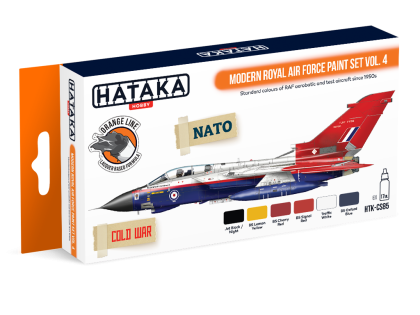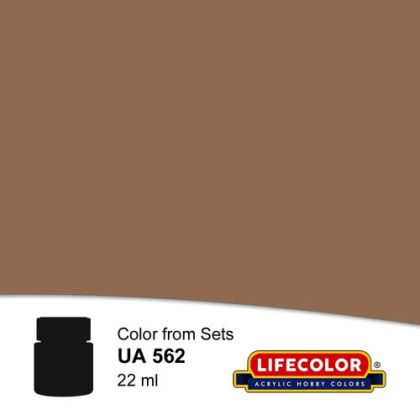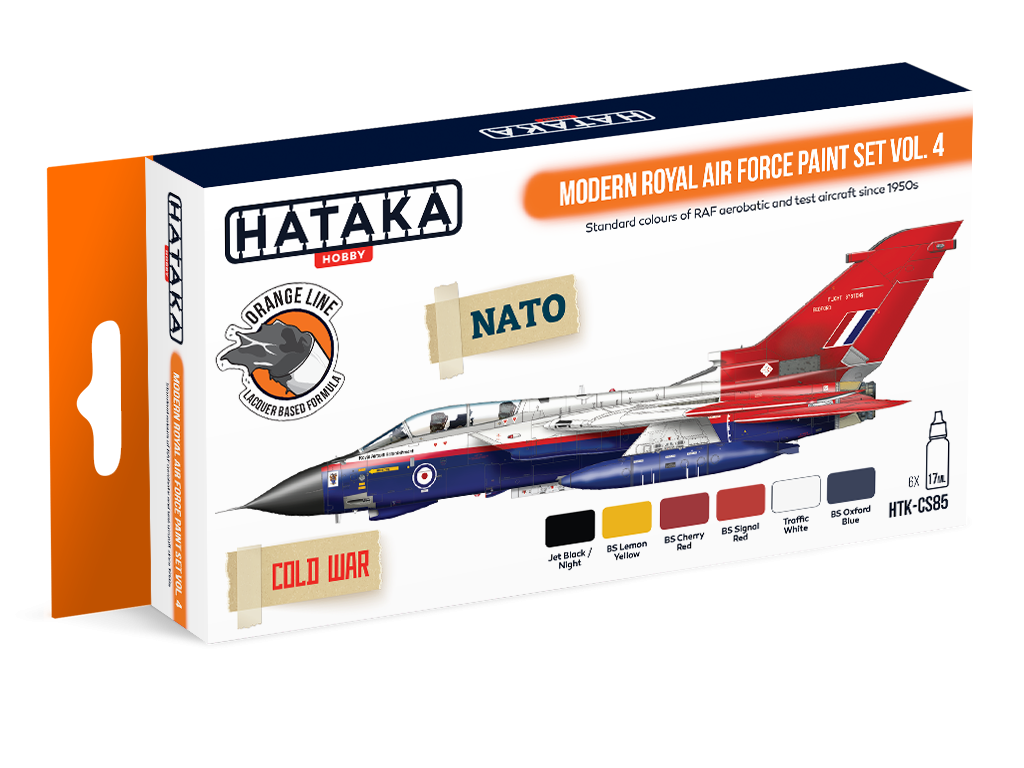
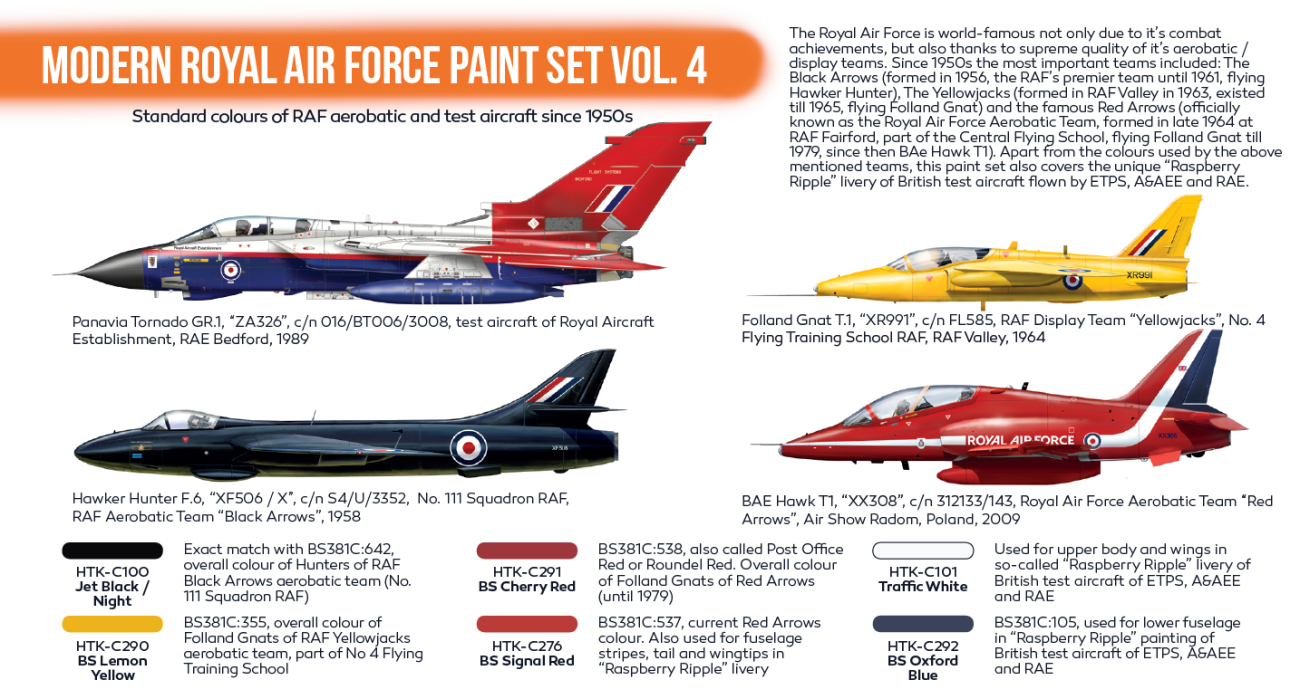
Six lacquer shades to the British standard, aimed at the striking coats of British aerobatic teams and test aircraft. From an all-black finish through two reds to white and dark blue.
Responsibility details are not available.
The Royal Air Force developed a tradition of public displays earlier than most European armed forces, and with it a tradition of eye-catching coats. The Hawker Hunters of No. 111 Squadron flew as the Black Arrows in an all-black finish, the Yellowjacks formation was given a rich lemon yellow for its Folland Gnat machines, and when the world-famous red nine grew out of it, the Gnats were repainted in a darker cherry shade. That lasted until the late 1970s, when it was replaced by a brighter signal red, which the team uses to this day. A chapter of its own is the white, red and blue coat of British test aircraft, which was nicknamed raspberry ripple for its striping.
A saturated black and both reds are among the most demanding shades there are. Black allows no unevenness of the surface, because every scratch shows through it as a light streak. Red, in turn, needs a neutral base, ideally a light gray one, otherwise it pulls toward orange or brown.
A lacquer base suits these colors, because it dries into an even coat without graininess and takes polishing.
With the display teams it also pays to apply the paint only over a polished base, because gloss is as much a part of the look of these machines as the shade itself.
Naši poradci a znalci sortimentu jsou připraveni odpovídat na Vaše dotazy (Po–Pá, 8–18 hod).
Zeptejte se na co potřebujete, odpovíme co nejdříve.
Texts from customers in the advice section reflect solely the opinions and views of the customers. MNF trade s.r.o. does not approve or verify customer texts in advance.
There are no questions here yet. Be the first to ask!