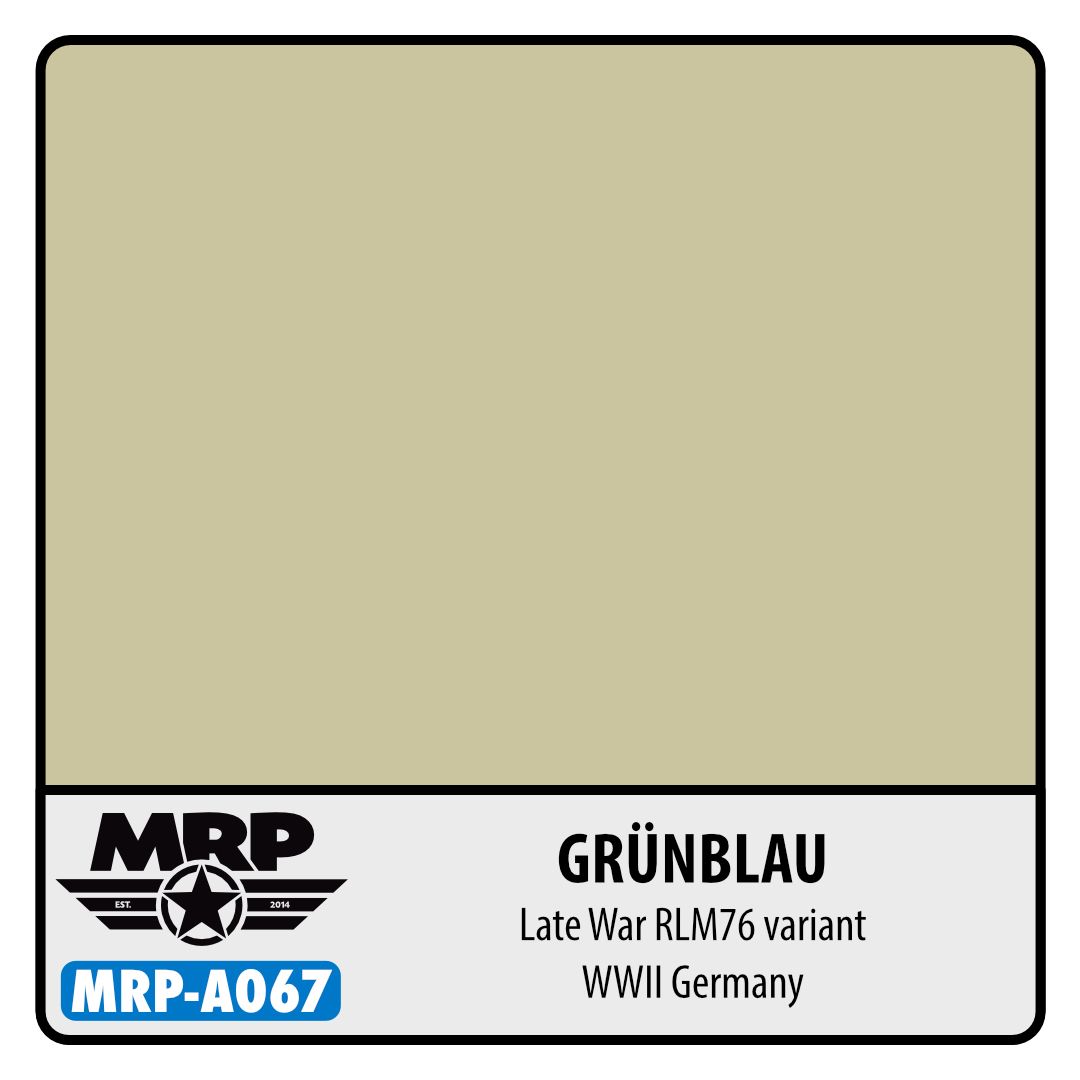
A light shade of the undersides of German Second World War aircraft in a greenish version. A water-thinnable acrylic paint made for an airbrush.
Responsibility details are not available.
The light tone designated number 76 covered the undersides and fuselage sides of German fighters from the late 1930s onward, disappearing under the mottled camouflage. In reality it was not a single color: depending on the lacquer manufacturer and the production period, it shifted from nearly white through blue-gray to a distinctly greenish shade, of the kind this bottle carries.
The greenish variant appears mainly on aircraft from the later war years, when formulas changed based on whatever was available at the time. Modelers reach for it where period photos show the underside lighter than the spine, but noticeably warmer than a pure blue; the difference tends to show up mainly in photos taken in clear weather.
The typical pattern on the vertical tail surface and the fuselage sides is achieved by spraying heavily thinned paint through a nozzle 0.2 mm in diameter from a short distance. Pressure under one bar gives a soft mottle with no spidering around it; higher pressure, by contrast, scatters the paint into grains.
A test spray onto a piece of cardboard saves a lot of frustration, since a few tenths of a bar and one centimeter of distance decide the difference between a soft mottle and a bled-through blotch. Fixing an oversprayed pattern is only possible by going back to the base color and recoating the whole area.
Naši poradci a znalci sortimentu jsou připraveni odpovídat na Vaše dotazy (Po–Pá, 8–18 hod).
Zeptejte se na co potřebujete, odpovíme co nejdříve.
Texts from customers in the advice section reflect solely the opinions and views of the customers. MNF trade s.r.o. does not approve or verify customer texts in advance.
There are no questions here yet. Be the first to ask!












