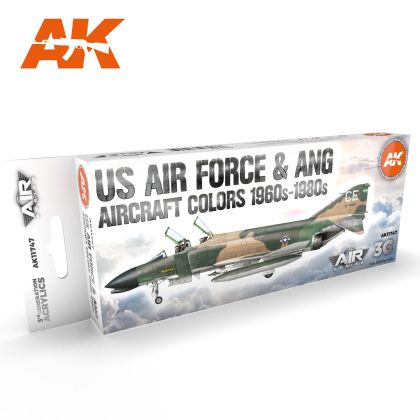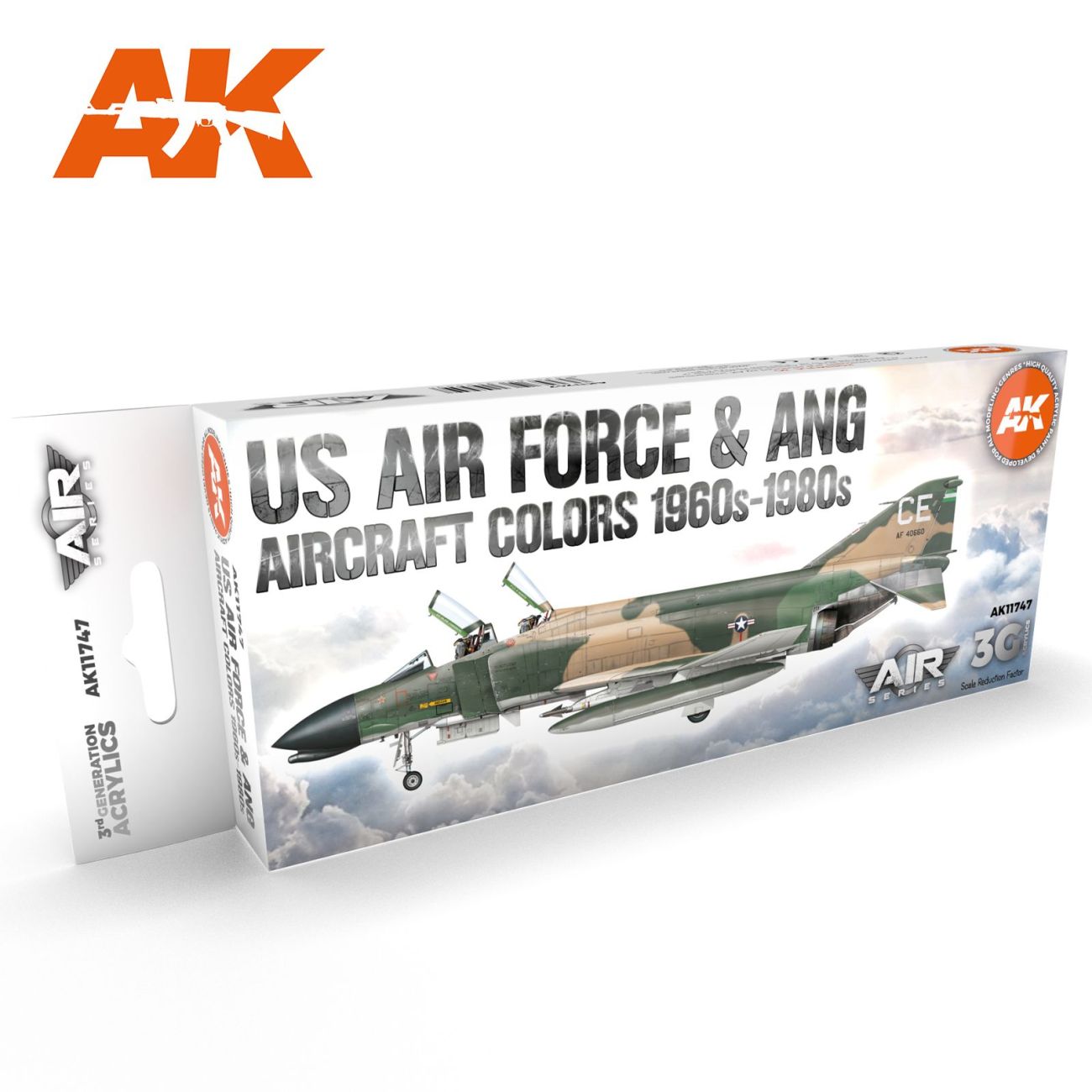


Eight shades covering American aircraft schemes of two decades: the Southeast Asia camouflage, the gray of air defense fighters and the later gray finishes.
Responsibility details are not available.
The period from the 1960s to the 1980s was a time for the US Air Force when the finishes of its machines changed faster than ever before. The silvery and gray finishes of the 1950s were replaced in Southeast Asia by a three-color camouflage with a brown component, and that then withdrew gradually in Europe in favor of unobtrusive grays. Air National Guard machines meanwhile kept the old patterns not infrequently longer than regular units, so both generations of finish could be met side by side on one base.
The three of the Southeast Asia camouflage are a forest green, a dark green and a sand brown, joined by a camouflage gray for the lower surfaces. Standing on its own is the light gray air defense finish carried by interceptors. The last three items, a subdued dark green, an ash gray and a medium dark gray, belong to the later transitional and low-visibility patterns. Each shade is listed under its own Federal Standard number, so it can be looked up outside this selection too.
A three-color camouflage stands or falls on how the boundary between the fields looks. Period finishes had soft but narrow edges, which is imitated on a model by spraying from a short distance at low pressure. Anyone who prefers certainty can use masking putty backed by a thin roll, so that the edge does not sit tight against the surface. It pays to work from the lightest tone to the darkest and to leave the lower surfaces until the end, when the model can safely be turned over.
Naši poradci a znalci sortimentu jsou připraveni odpovídat na Vaše dotazy (Po–Pá, 8–18 hod).
Zeptejte se na co potřebujete, odpovíme co nejdříve.
Texts from customers in the advice section reflect solely the opinions and views of the customers. MNF trade s.r.o. does not approve or verify customer texts in advance.
There are no questions here yet. Be the first to ask!