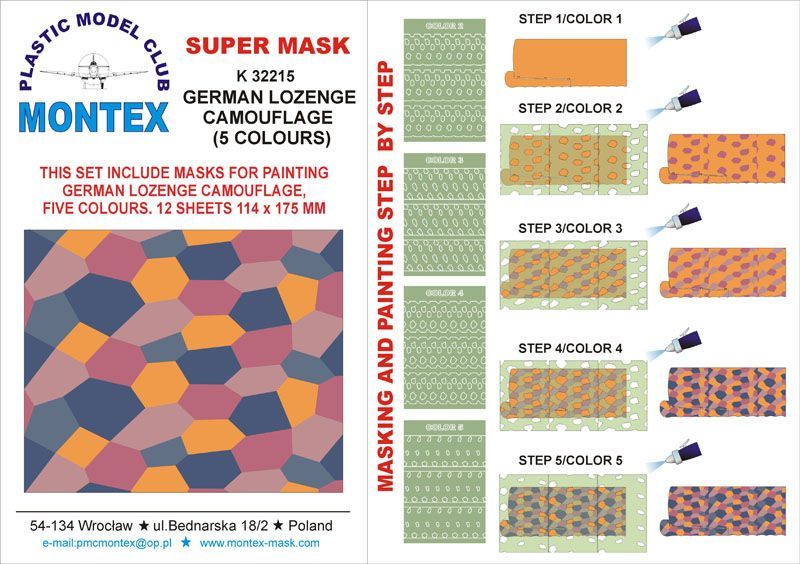

A set of self-adhesive stencils for spraying the five-color lozenge on the covering of German aircraft of the First World War. Twelve sheets, 1:32 scale.
Responsibility details are not available.
In 1917 the German air service stopped painting camouflage onto the covering and began to order it straight from the textile mills. The fabric arrived at the assembly shop already carrying a mosaic of polygons in five shades, so once it was stretched over the framework nothing had to be painted in. The reason was purely practical: a finish on stretched fabric added kilograms, stiffened it and cracked at every flexing.
The five-color version belonged to the upper surfaces, that is the wing covering and the fuselage spine of machines such as the Fokker D.VII or the Halberstadt. The rolls of fabric were laid on the wing at an angle and every factory had a habit of its own, so the slope of the fields differed from one machine to the next. This was not random mottling. A regular mosaic of small areas broke up the outline of a machine seen from above against a varied landscape more effectively than any single shade, and at the same time it could be printed on a large scale.
Drawing hundreds of polygons by hand in this scale is weeks of work and a single unsteady edge shows. The package therefore carries twelve sheets of self-adhesive material from which the whole pattern is built up field by field. You work from the base tone to the further shades, always with the edge pressed down thoroughly so that paint does not get under the film.
Naši poradci a znalci sortimentu jsou připraveni odpovídat na Vaše dotazy (Po–Pá, 8–18 hod).
Zeptejte se na co potřebujete, odpovíme co nejdříve.
Texts from customers in the advice section reflect solely the opinions and views of the customers. MNF trade s.r.o. does not approve or verify customer texts in advance.
There are no questions here yet. Be the first to ask!