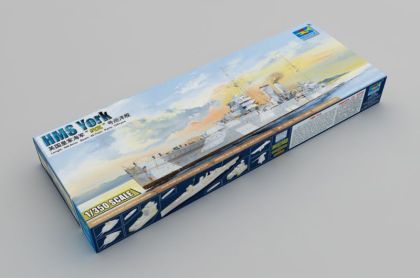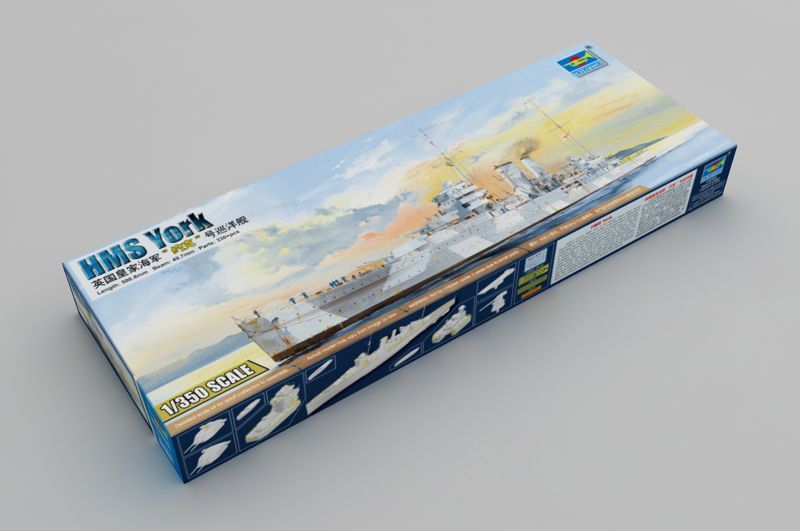
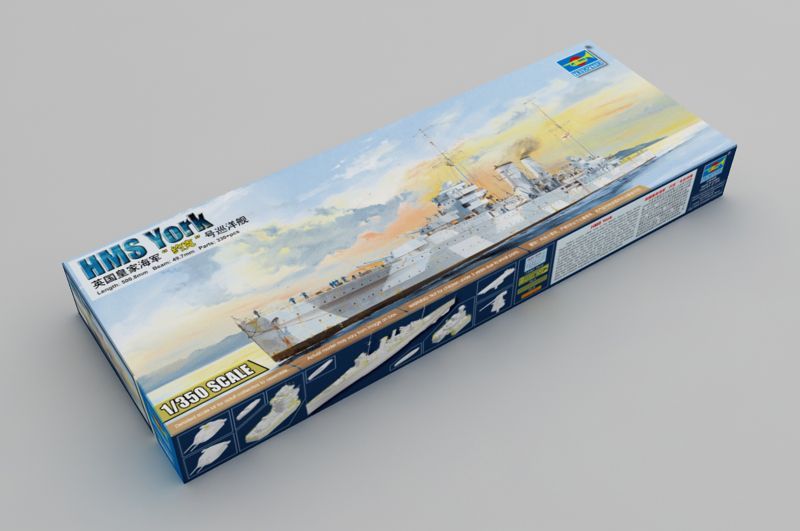
A plastic kit of the British heavy cruiser HMS York in 1:350 scale from the maker Trumpeter. According to the maker the package holds photo-etched parts, a metal anchor chain and a stand; the finished model measures around 50 cm.
Responsibility details are not available.
An unassembled plastic kit of the British heavy cruiser HMS York in 1:350 scale from Trumpeter. The maker states more than 330 parts on seventeen sprues, a hull shaped with slide molds, decks with finely rendered plank texture, photo-etched parts, a metal anchor chain, decals and a stand. The finished model is roughly 50 cm long and around 5 cm wide, which for a cruiser with a slender hull is a respectable piece for the display cabinet. The hull is built as a full hull and there is a stand in the box; the maker does not declare a waterline variant cut at the load line. The tooling is modern, from the end of the second decade of this century, and the fineness of the engraving matches that.
York was the lead ship of her class of Royal Navy heavy cruisers: compared with the older County class cruisers she was a more economical and smaller design with eight-inch guns in twin turrets. Her end is one of the most dramatic stories of the war in the Mediterranean: on 26 March 1941, in Suda Bay on Crete, she was hit by Italian explosive motorboats, small craft loaded with explosive which the pilot left shortly before impact. The explosions flooded the boiler rooms and the engine room and York had to be deliberately run aground so that she would not sink. Air attacks then went on damaging the immobilized wreck and with the fall of Crete she was lost for good. York is thus a textbook example of how cheap attack weapons put a heavy warship out of action.
On a ship model the main work is in the superstructure, the armament, the boats, the railings and the rigging, not in the hull, so count on a large number of small parts and build in subassemblies. Paint the hull and the decks before the superstructures go onto them, as the areas between the upper deck structures are hard to get at later. Glue the plastic with thin extra-liquid cement and the photo-etch and the metal chain with super glue. Spray the gray Royal Navy camouflage schemes with an airbrush in thin layers and lay out the transitions with masking tape. A panel wash and discreet dry brushing on the edges will bring the detail out. Railings and ladders on ships in 1:350 are normally handled with photo-etch: a basic etched sheet is part of the kit, while a complete set of railings is bought separately. Run the rigging last of all.
The model is supplied unassembled and unpainted. Glue, paints and accessories are not included in the package, unless stated otherwise.
Naši poradci a znalci sortimentu jsou připraveni odpovídat na Vaše dotazy (Po–Pá, 8–18 hod).
Zeptejte se na co potřebujete, odpovíme co nejdříve.
Texts from customers in the advice section reflect solely the opinions and views of the customers. MNF trade s.r.o. does not approve or verify customer texts in advance.
There are no questions here yet. Be the first to ask!