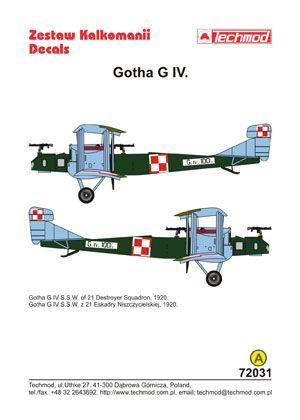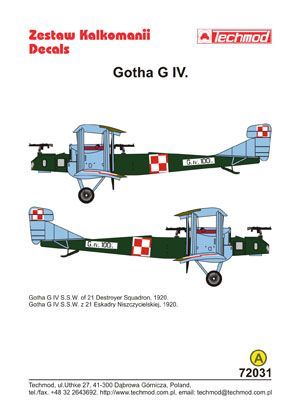
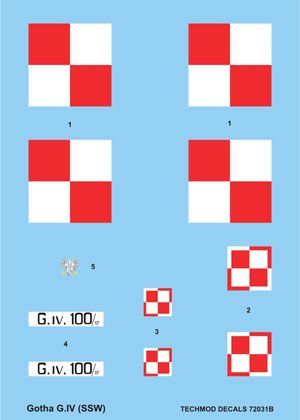
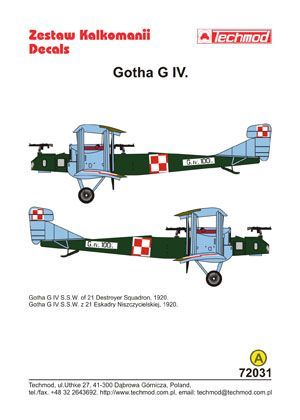
Decals for the twin engine Gotha G.IV bomber from licensed production by Siemens-Schuckert, in the equipment of the Polish 21st Escadrille in 1920. Scale 1:72.
Responsibility details are not available.
The Gotha G.IV was a large twin engine long range machine with which Germany mounted day and night raids on England from 1917. The machine had a span of over twenty-three meters, a crew of three and carried several hundred kilograms of bombs. Besides the parent works it was built by licensed plants as well, among them Siemens-Schuckert Werke, and it is to that series that the abbreviation in the brackets of the name refers. These were the first raids on London led by aircraft rather than by airships.
After the armistice was signed, dozens of such aircraft remained on territory that fell to the restored Polish state, and the new air arm took them into its strength without hesitation. In 1920, in the middle of the war with Bolshevik Russia, these Gothas were among the few machines capable of carrying a heavier bomb load. They served with the 21st Escadrille, which Polish aviation led under the designation niszczycielska, that is destroyer. Within a few weeks the red and white checkerboard replaced the German crosses on the fabric.
A biplane model has a great many surfaces and decals are applied to it at a stage when the upper wing is often not yet fitted. It therefore pays to plan the order of work and to apply the markings to the underside of the upper wing before the struts make it inaccessible. The covering is fabric, so a decal softener will be needed. The package holds only the printed sheet; the kit itself and glue are obtained separately.
Naši poradci a znalci sortimentu jsou připraveni odpovídat na Vaše dotazy (Po–Pá, 8–18 hod).
Zeptejte se na co potřebujete, odpovíme co nejdříve.
Texts from customers in the advice section reflect solely the opinions and views of the customers. MNF trade s.r.o. does not approve or verify customer texts in advance.
There are no questions here yet. Be the first to ask!