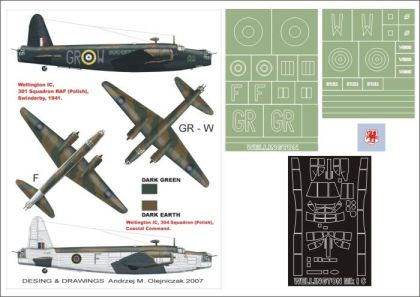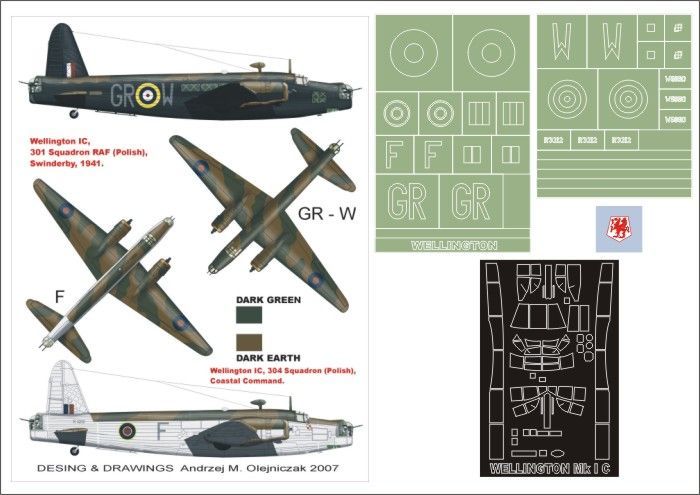
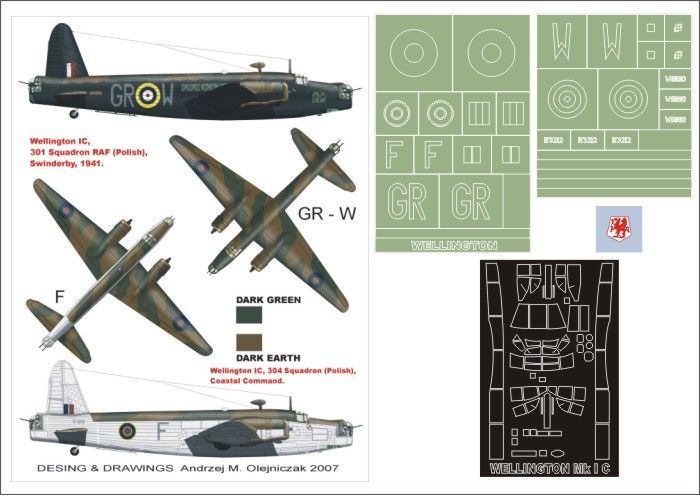
Masks for the Vickers Wellington Mk IC night bomber in 1:48. They cover the glazing of the turrets and of the pilots' cockpit from outside and add three sheets for the roundels plus decals.
Responsibility details are not available.
The Vickers Wellington stood on a skeleton nobody else used. Barnes Wallis assembled it from thousands of short aluminum sections woven into a net over which fabric was stretched. A hit in such a structure made a hole but did not interrupt the line of stress, and machines came back with the fuselage shot into lace. The IC version was the most numerous and differed in armament: instead of a retractable ventral turret it received a pair of side windows with movable machine guns. Until the summer of 1942 it carried the main weight of the night campaign over the continent.
A bomber does not have one canopy, it has a whole row of them and each in a different place. At the front a turret made up of small panes rotates, and beneath it lies the bomb aimer's sighting window. The pilots' space is covered by flat panels with sliding side windows. Above the spine a transparent dome for astronomical navigation projects, along the sides of the fuselage runs a row of rectangular windows and right at the back sits a second rotating turret. Seven separate assemblies mean seven independent tasks, for which tape would not be enough either in time or in accuracy.
Three sheets are no accident on this item. A bomber carries markings on both sides of the fuselage, on the upper and lower surfaces of the wing and on the vertical tail surface, so the consumption of masks is several times that of a fighter.
Naši poradci a znalci sortimentu jsou připraveni odpovídat na Vaše dotazy (Po–Pá, 8–18 hod).
Zeptejte se na co potřebujete, odpovíme co nejdříve.
Texts from customers in the advice section reflect solely the opinions and views of the customers. MNF trade s.r.o. does not approve or verify customer texts in advance.
There are no questions here yet. Be the first to ask!