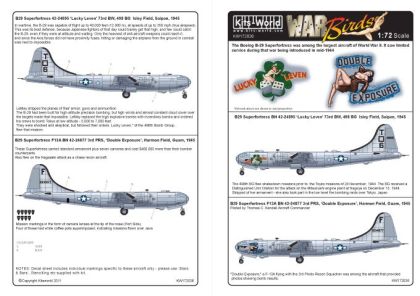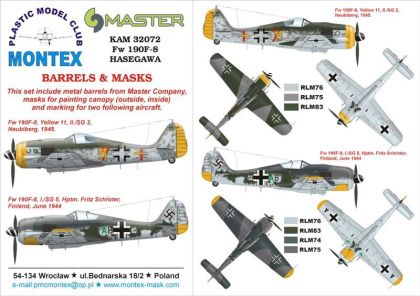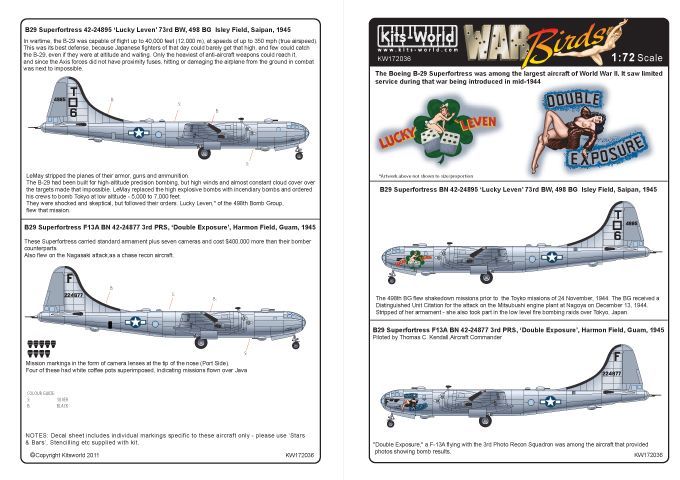
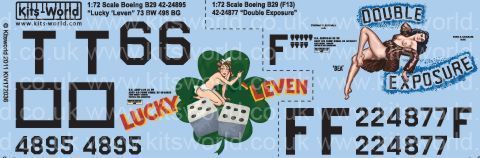
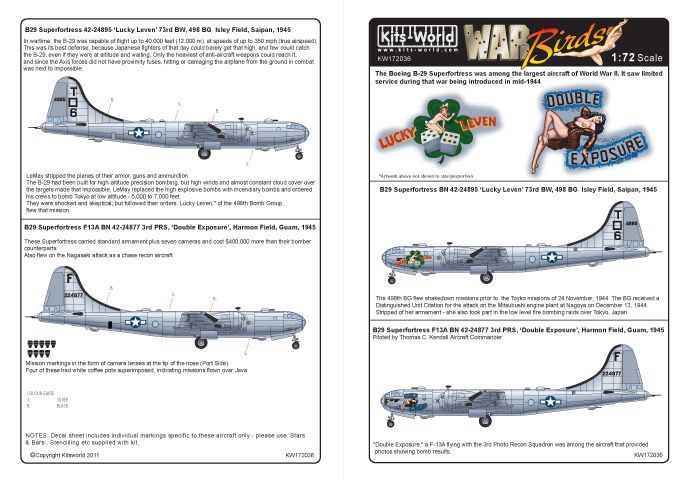
Markings 1:72 for two Superfortresses from the fighting over Japan: a bomber of the 498th Group and a photo reconnaissance F-13A with seven cameras.
Responsibility details are not available.
The Superfortress entered the war as the most complex production aircraft of its day: a pressurized cabin, remotely operated turrets and a range no other bomber had. The sheet aims at two machines from the Pacific deployment and sets two guises of the same airframe side by side, the combat one and the reconnaissance one.
The first is a bomber with the serial number 42-24895 and the name Lucky Leven, listed with the 498th Bomb Group, which came under the 73rd Bomb Wing. The second is Double Exposure, serial number 42-24877, converted to the F-13A version and deployed with the 3rd Reconnaissance Squadron.
According to the supplier these photographic Superfortresses kept the standard defensive armament and in addition got seven cameras into the fuselage. The cost of one example thereby grew by roughly four hundred thousand dollars over the bomber version. It was precisely the photographs from these aircraft that marked out the targets for the later raids, so the crews headed deep over the Japanese islands before the bomber formations got there, and came back with thousands of meters of film.
Natural metal is the most demanding surface for decals, because every unevenness of the film shows against the glossy area. It pays to seal the surface with gloss clear first, to seat the decals one at a time and to blot the water off from underneath at once. On the large areas of the fuselage a stronger decal softener helps, as it draws the film down onto the metal.
Naši poradci a znalci sortimentu jsou připraveni odpovídat na Vaše dotazy (Po–Pá, 8–18 hod).
Zeptejte se na co potřebujete, odpovíme co nejdříve.
Texts from customers in the advice section reflect solely the opinions and views of the customers. MNF trade s.r.o. does not approve or verify customer texts in advance.
There are no questions here yet. Be the first to ask!