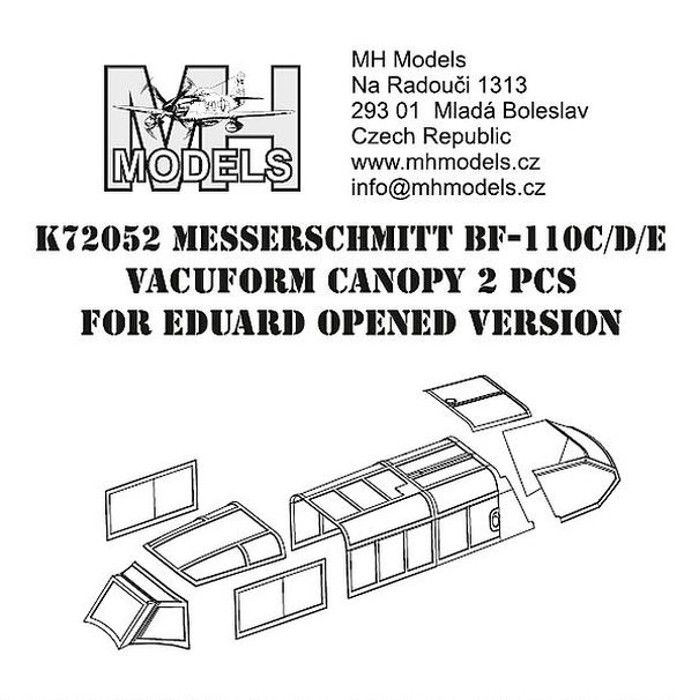
Vacuum-formed cockpit glazing for the Messerschmitt Bf 110 heavy fighter in the C, D and E versions in 1:72 scale, in the form with the canopy sections open. The formed film is thinner than a molded part.
Responsibility details are not available.
The Messerschmitt Bf 110 was created as a long-range Zerstörer, a heavy fighter that was to escort bomber formations deep over enemy territory. In the Battle of Britain it lost badly against single-engine opponents, but in the role of a fighter-bomber and later a night fighter it stayed in service until the end of the war. The C, D and E forms differed mainly in equipment for long range and in the ability to carry bombs under the fuselage.
The formed glazing is made of clear film and offers the cockpit in the open state, that is, with the sections slid back. The material tends to be noticeably thinner than an injection-molded part, so the frames do not look bulky and the interior is visible beneath them as it should be.
The cut-out is made with a margin and the outline is then sanded on fine paper laid on a flat board until the edge sits exactly on the fuselage. Work in small steps and dry-fit often, because what has been taken off cannot be put back. It is bonded with clear PVA glue, which does not cloud the surface, and the framing is handled with a mask or narrow strips of tape.
An open cockpit makes sense above all when there is something to see in the model; it is therefore worth adding at least the belts and the side panels to the interior. Try the cut-out on the model first with the edge unsanded, so that you know how much material you may take off.
Naši poradci a znalci sortimentu jsou připraveni odpovídat na Vaše dotazy (Po–Pá, 8–18 hod).
Zeptejte se na co potřebujete, odpovíme co nejdříve.
Texts from customers in the advice section reflect solely the opinions and views of the customers. MNF trade s.r.o. does not approve or verify customer texts in advance.
There are no questions here yet. Be the first to ask!