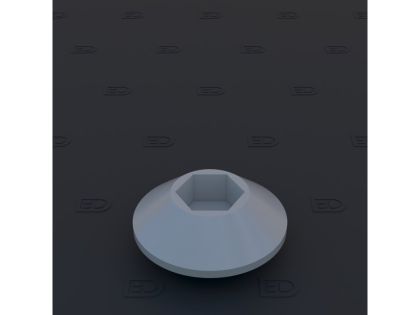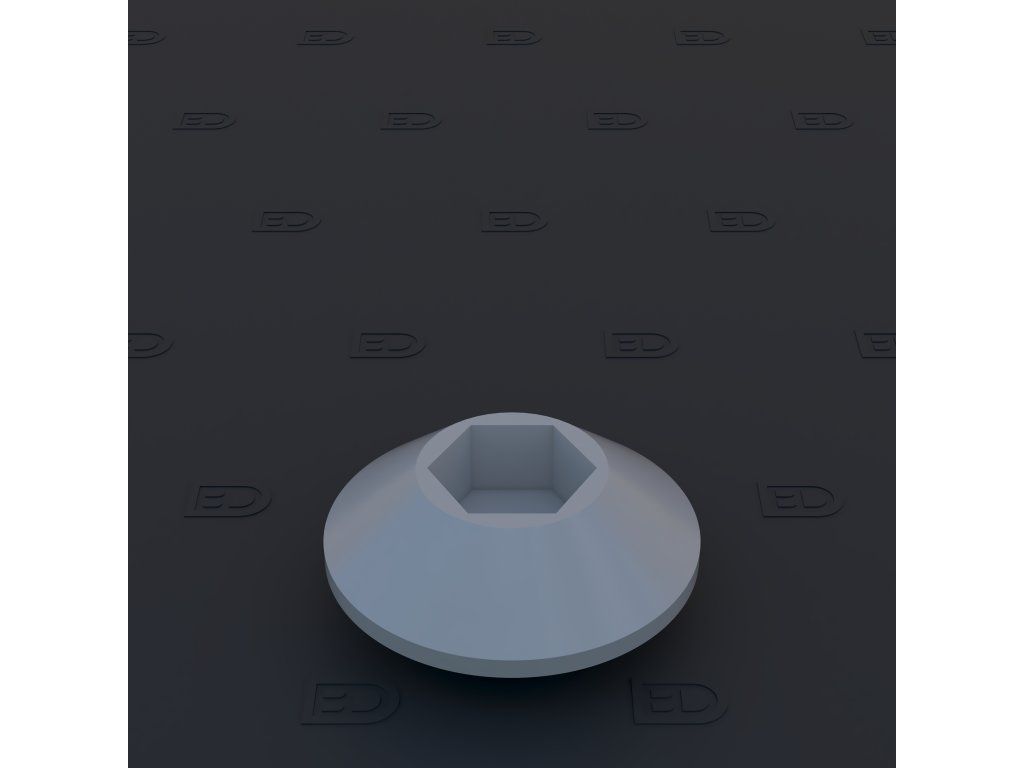
A cone head with an Allen recess, a diameter of exactly 1.0 mm. The boundary beyond which a small joint turns into a structural element.
Responsibility details are not available.
A round number is tempting. When choosing a size, most builders reach for the full millimeter simply because it is easy to remember, and only on the finished part do they find that the surface has coarsened. The conversion explains it at once: in the automotive scale of 1:24 this diameter means a head 24 mm wide in reality, which is the size of a heavy M16 screw on a wheel suspension, not of an ordinary body joint.
In larger scales the ratio turns around. On an eighth-scale or a 1:6 build of a road machine the same head works out at eight to twelve millimeters of real size, that is at a perfectly ordinary joint of a fender, a footpeg or a disc brake. The same component is thus coarse and fine depending on what you set it into, and that is the only figure that decides its suitability.
Before you drill, lay the element on the place dry and look at the part from a distance of about half a meter, that is from the ordinary viewing distance of a display cabinet. If you take in the head from that distance before the shape of the whole, it is too large for the place. The camera in a phone manages this test even more reliably than the eye.
A cone sunk into the seating surface keeps the surface smooth and lets the hexagonal recess stand out, which at this diameter already casts a distinct shadow even without being brought out with a wash. In a close photograph of a model it is one of the elements that most gives away the scale of the whole build.
Naši poradci a znalci sortimentu jsou připraveni odpovídat na Vaše dotazy (Po–Pá, 8–18 hod).
Zeptejte se na co potřebujete, odpovíme co nejdříve.
Texts from customers in the advice section reflect solely the opinions and views of the customers. MNF trade s.r.o. does not approve or verify customer texts in advance.
There are no questions here yet. Be the first to ask!