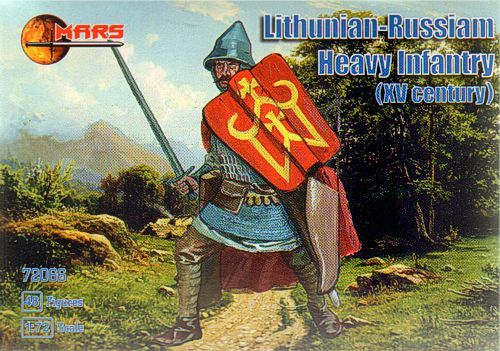
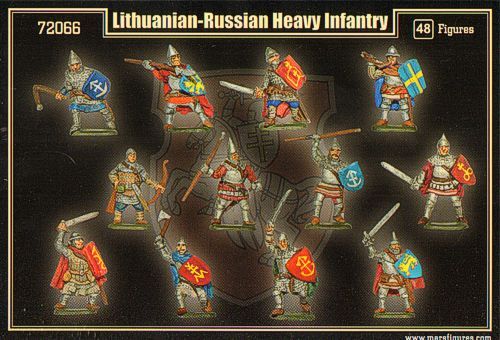
Heavy infantry of the Lithuanian-Russian armies of the fifteenth century. A set of small castings in 1:72 intended to be assembled and painted.
Responsibility details are not available.
A heavy foot soldier is told from a light one not by the amount of equipment but by the way he stands. His feet are farther apart, the knees slightly bent, the center of gravity lower and the soles flat. Anyone who keeps to that on the groundwork gains the impression of men who are not about to give way anywhere; a figure placed on its toes, on the other hand, denies the whole point of heavy infantry even if it is wrapped in armor from head to foot.
In a closed formation a peculiar rule applies on top of that: the smaller the intervals, the greater the impression of strength. A line of figures placed tightly side by side merges into one block and looks like a wall, whereas a loose arrangement of the same castings looks like a patrol on the march. What decides, then, is the interval and not the number.
An interesting contrast arises when several lighter figures in movement are placed behind such a block. The calm mass in front and the flowing line behind give a scene depth that heavy infantry alone in a single rank would never achieve. It is a cheap way of making a scene with two planes out of one set.
When gluing, the uprightness of the figures deserves attention. A rank in which one figure leans forward and the next backward loses its air of closeness faster than any inaccuracy in color. This is checked by looking from the side, never from above.
Naši poradci a znalci sortimentu jsou připraveni odpovídat na Vaše dotazy (Po–Pá, 8–18 hod).
Zeptejte se na co potřebujete, odpovíme co nejdříve.
Texts from customers in the advice section reflect solely the opinions and views of the customers. MNF trade s.r.o. does not approve or verify customer texts in advance.
There are no questions here yet. Be the first to ask!