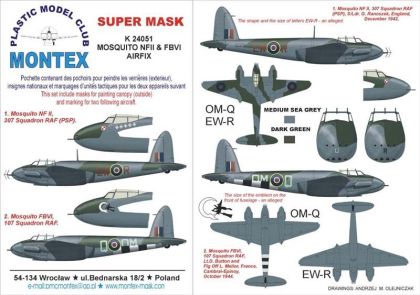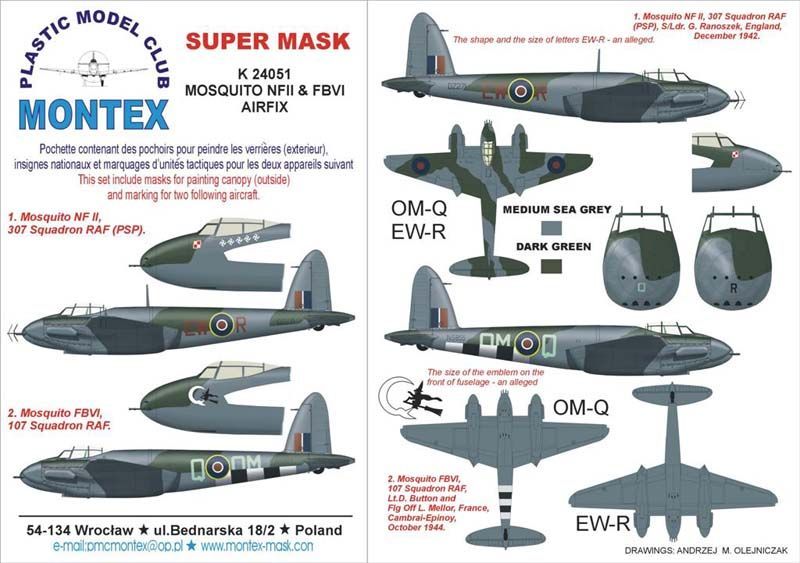
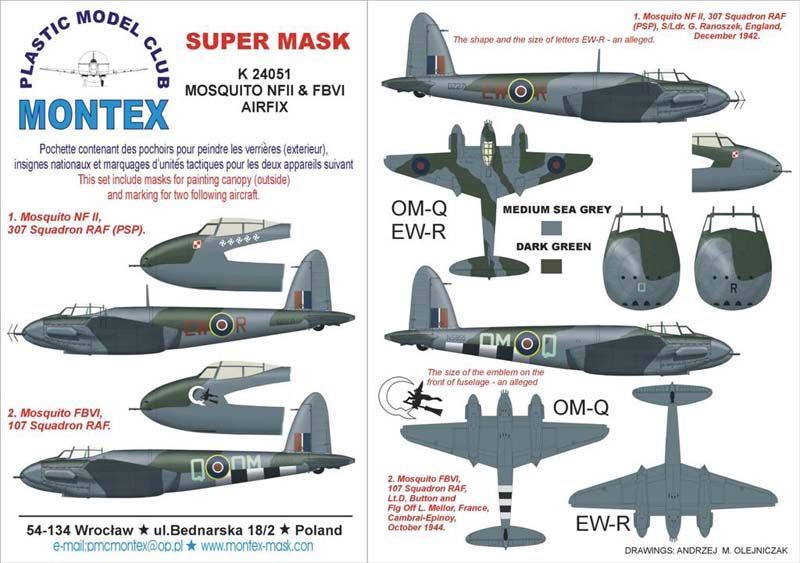
Stencils for spraying the glazing and markings of the twin-engine de Havilland Mosquito in 1:24. Five parts for the national insignia, the cockpit covered from both sides.
Responsibility details are not available.
The Mosquito came about against the will of the authorities as a fast bomber with no defensive armament, built mainly of plywood and balsa. The bet on wood had a practical reason: it did not burden the metal industry and it allowed furniture workshops to be brought in. The result was a machine that for a long time simply could not be caught, and so it gradually became a night fighter, an attack aircraft, a reconnaissance machine and a pathfinder.
The glazing of this type is extraordinarily broken up. The pilot and the navigator sit side by side under a glazed superstructure, the front pane is flat and armored and the side windows follow the rounded shell of the fuselage. In a large reduction there are dozens of small fields, and taping them one at a time is work for a whole evening.
The set deals with that by means of pre-cut shapes. A pair covers the glazing from the outside and from the inner side, so the frames look identical from both views, and with them five parts for the national insignia are enclosed.
With so many small fields it pays to work in sections and to take the shapes off as you go, not at the end. Dried paint at the edges joins the individual parts together and during a mass removal the neighboring pieces come off too. Tweezers with flat jaws also prove useful, because a part can be lifted by a corner without touching the freshly painted area beside it.
Naši poradci a znalci sortimentu jsou připraveni odpovídat na Vaše dotazy (Po–Pá, 8–18 hod).
Zeptejte se na co potřebujete, odpovíme co nejdříve.
Texts from customers in the advice section reflect solely the opinions and views of the customers. MNF trade s.r.o. does not approve or verify customer texts in advance.
There are no questions here yet. Be the first to ask!