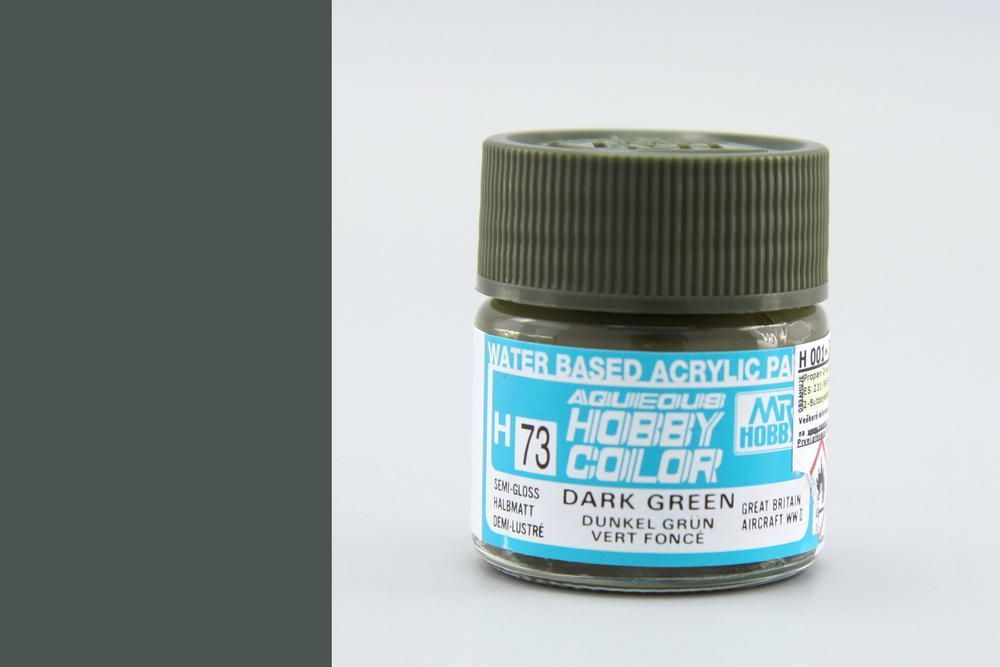

The green component of British upper camouflage in an acrylic version. Ten milliliters of paint thinnable with water, intended for spraying and for brush painting.
Responsibility details are not available.
From the late 1930s the upper surfaces of British aircraft carried a combination of brown and green, and the green tone stayed in use considerably longer. After 1941, when the fighting moved over the continent, the brown disappeared from most machines and was replaced by gray, whereas the green stayed on the spines practically until the end of the war.
It also appears on the aircraft of Coastal Command, on cargo gliders and on a number of twin-engine types. The shade is dark and not very saturated; once dry it looks noticeably more muted than in the bottle, which is usual with camouflage colors and should be reckoned with when mixing shades. Anyone who wants to be sure sprays a test sample onto a piece of plastic, leaves it overnight and only then compares it with a reference or with a decal.
A sprayed coat sets within a few minutes, but full curing of the binder takes considerably longer. So lay the second pass on only after a longer pause, otherwise the layer underneath will lift and the surface will go grainy. Rinse brushes and the gun's cup out immediately after work, as dried acrylic only comes off mechanically.
A thin oil paint filter, applied over a perfectly cured and varnished surface, will deepen the area optically. Dry pigment rubbed into the gaps at the wing root serves equally well, where on real machines the dirt held longest.
Naši poradci a znalci sortimentu jsou připraveni odpovídat na Vaše dotazy (Po–Pá, 8–18 hod).
Zeptejte se na co potřebujete, odpovíme co nejdříve.
Texts from customers in the advice section reflect solely the opinions and views of the customers. MNF trade s.r.o. does not approve or verify customer texts in advance.
There are no questions here yet. Be the first to ask!