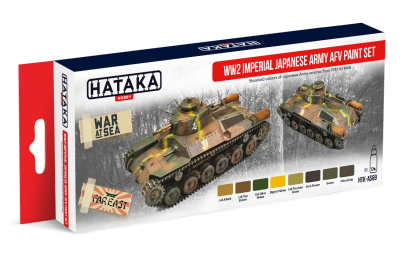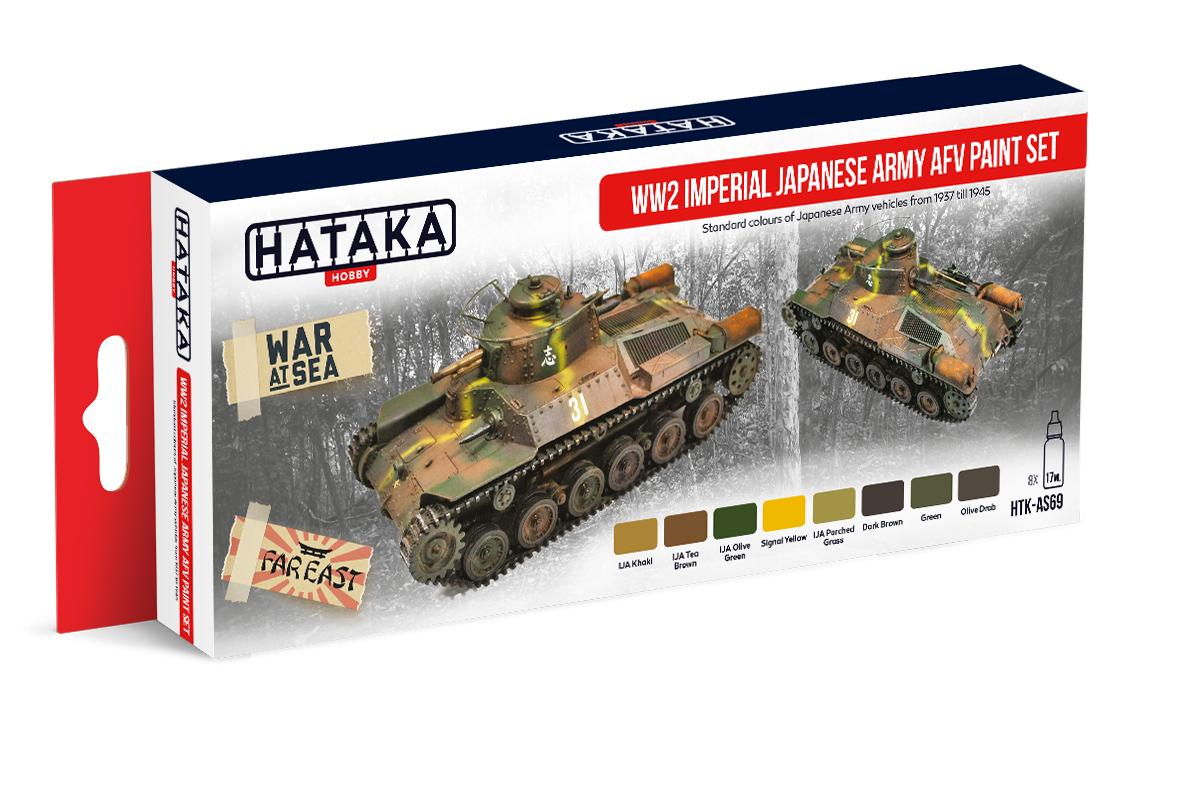
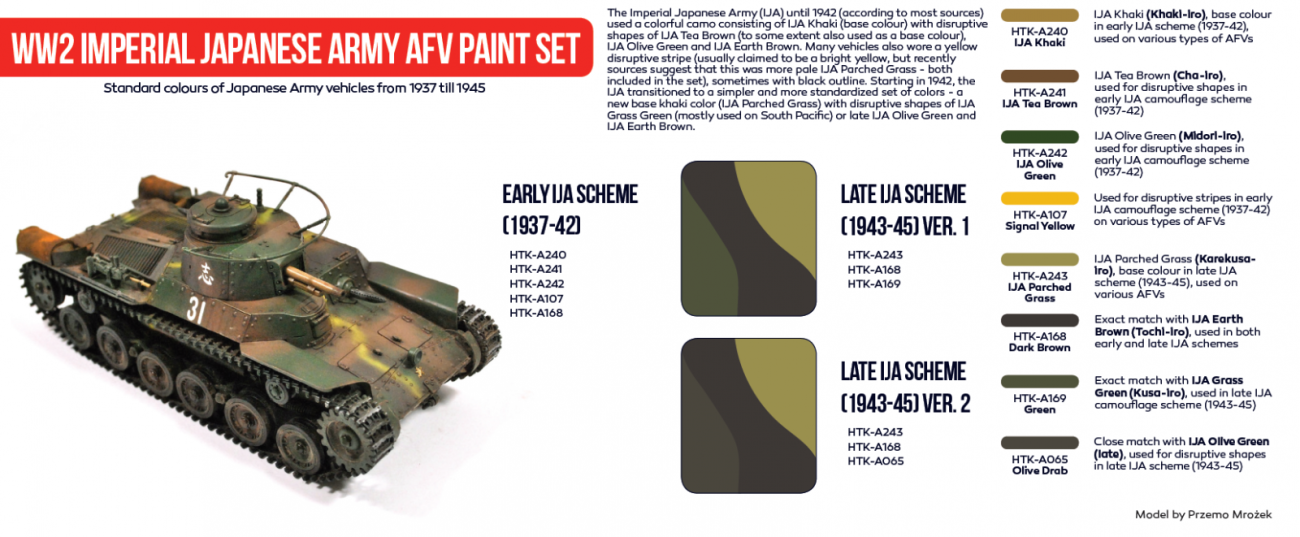
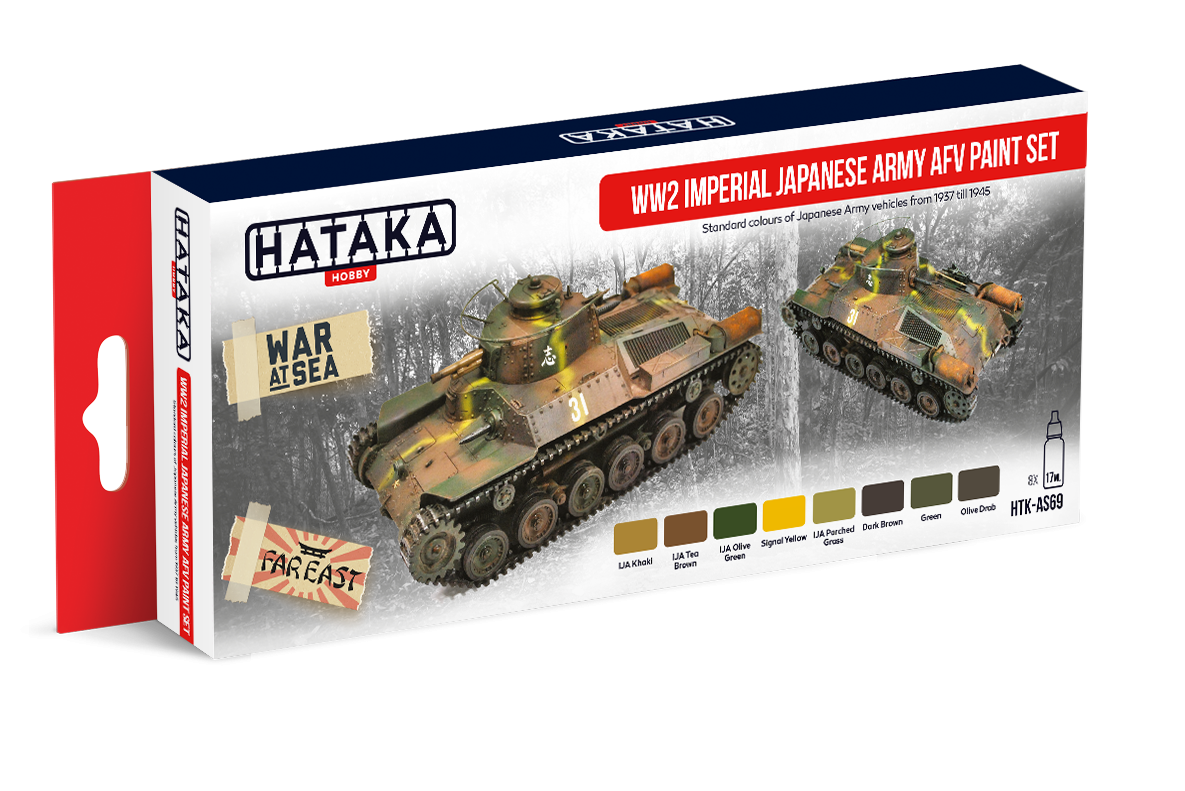
Eight colors of Japanese armored vehicles from 1937 to 1945: the early scheme with yellow stripes and the late base in the shade of dried grass.
Responsibility details are not available.
The armored vehicles of the Imperial Japanese Army divide into two eras in terms of color, and this line-up covers both. Until 1942 the base tone Khaki-iro prevailed, over which irregular areas of brown Cha-iro and green Midori-iro were applied. The patches were separated by narrow yellow stripes, today probably the most striking identifying feature of Japanese vehicles of that time, and that is exactly why signal yellow is in the package.
From 1943 the base was replaced by the lighter Karekusa-iro, that is the color of dried grass, and it goes with a dark brown tone matching the earthy Tochi-iro, a green close to the grassy Kusa-iro and an olive shade with which the late disruptive areas were drawn. The earthy brown is common to both periods, so it also suits the older machines.
It is useful that each bottle is given with its period and the way it is used. A modeler therefore does not have to look up which tone is the base and which only an addition, and there is no risk of the common mix-up in which the late light base turns up on a vehicle from the fighting in China. The set is aimed at armored vehicles, not at aircraft, whose Japanese palette looks quite different. For a diorama of the Pacific campaign that means one package can paint a light tank and a tractor while keeping between them the color harmony that factory finishes from one batch had.
Naši poradci a znalci sortimentu jsou připraveni odpovídat na Vaše dotazy (Po–Pá, 8–18 hod).
Zeptejte se na co potřebujete, odpovíme co nejdříve.
Texts from customers in the advice section reflect solely the opinions and views of the customers. MNF trade s.r.o. does not approve or verify customer texts in advance.
There are no questions here yet. Be the first to ask!