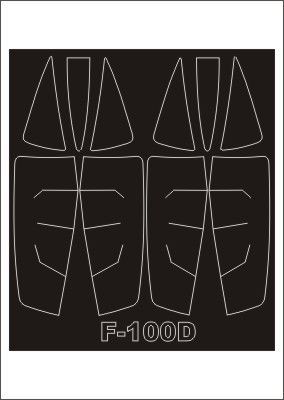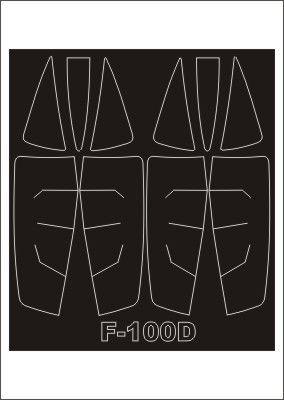
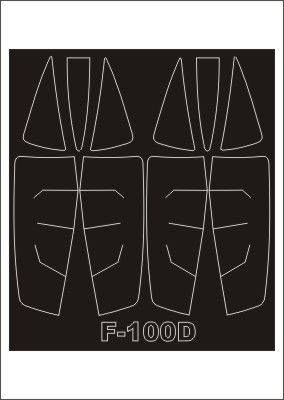
A masking set for the glazing of the supersonic North American F-100 Super Sabre attack aircraft in 1:32 scale.
Responsibility details are not available.
The Super Sabre passed the speed of sound in level flight as early as 1953 and from the start it was treated as a machine at the limit of what was then possible: it was sensitive on landing and in its first years it had a high accident rate. Its real career, however, came not from air combat but from Vietnam. From the airfields of Bien Hoa and Phu Cat it flew more combat sorties than all the American fighters of the Second World War together, and exclusively in support of ground units.
In the 1950s the machines flew unpainted in Europe and at home, with nothing but a corrosion-resistant lacquer, a prominent number on the vertical surface and a band in the squadron color. By 1965 that had been replaced by the three-color Southeast Asia camouflage with a white underside, and the machines received the letter codes of their wing on the tail. Aircraft handed over to Turkey, Denmark and France then carried home markings and different numbering, so one type became several visually rather different families.
The cockpit of a jet has a narrow and clearly defined frame, so every inaccuracy is more glaring than on propeller aircraft. Cut shapes remove that problem and hold a sharp edge even on the curve of the windscreen. Parts for the inner side are in the set as well, which is useful with an open cockpit and the ejection seat in view.
Finish the seat and the instrument panel before you mask the canopy. Once the templates are on, the cockpit is hard to reach into.
Naši poradci a znalci sortimentu jsou připraveni odpovídat na Vaše dotazy (Po–Pá, 8–18 hod).
Zeptejte se na co potřebujete, odpovíme co nejdříve.
Texts from customers in the advice section reflect solely the opinions and views of the customers. MNF trade s.r.o. does not approve or verify customer texts in advance.
There are no questions here yet. Be the first to ask!