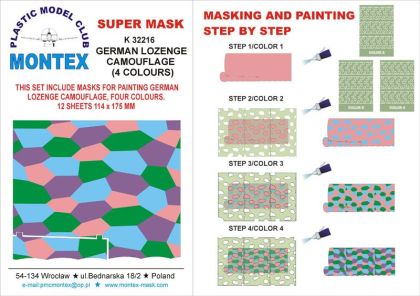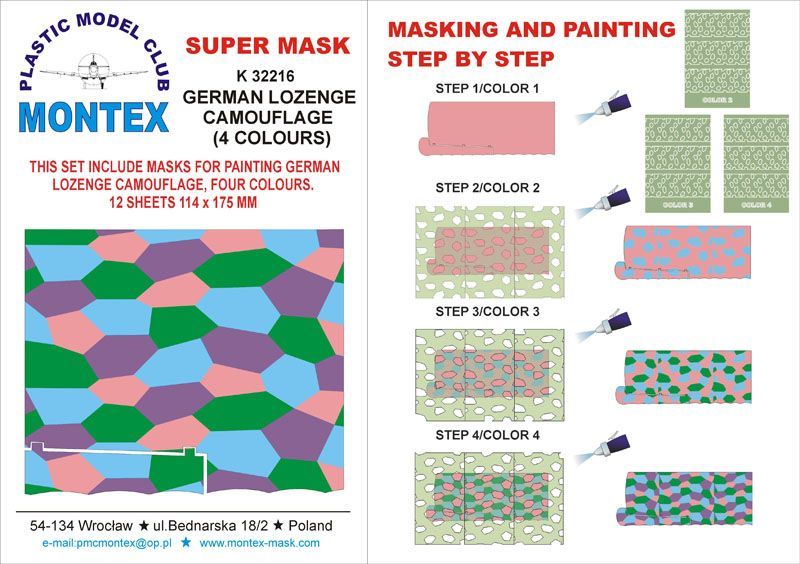

Masking sheets for the four-color variant of the lozenge in 1:32 scale. Twelve sheets of self-adhesive material for spraying the printed pattern.
Responsibility details are not available.
The printed fabrics were supplied in two palettes and the difference between them was not a matter of design. The lower surfaces of an aircraft are seen by an observer from below, that is against a light sky, and there dark earthy tones give themselves away at once. The four-color range therefore rests on lighter blue-gray and greenish shades that dissolve in backlight.
That is exactly why most machines from the end of the First World War have a sharp break in the pattern on the edge of the wing and on the sides of the fuselage: one palette above it, the other below. Anyone who does not notice carries one pattern over the whole airframe and the model immediately loses the character of its subject. The mosaic itself stays the same; only the set of colors changes, because the same shape of field worked above and below.
The stencils are laid on one after another, one layer of shade after the next, and each piece is pressed down around its perimeter so that paint does not run under the edge. On the lower surfaces it pays to thin more and spray weaker coats; light tones have less covering power and a heavy coat accentuates the step at the edge of the film.
The mosaic also forgives small inaccuracies out in the area, but not on the break. That is where the two palettes meet and the modeler's eye goes along that line first, so give it the most attention and stick it down after a dry run.
Naši poradci a znalci sortimentu jsou připraveni odpovídat na Vaše dotazy (Po–Pá, 8–18 hod).
Zeptejte se na co potřebujete, odpovíme co nejdříve.
Texts from customers in the advice section reflect solely the opinions and views of the customers. MNF trade s.r.o. does not approve or verify customer texts in advance.
There are no questions here yet. Be the first to ask!