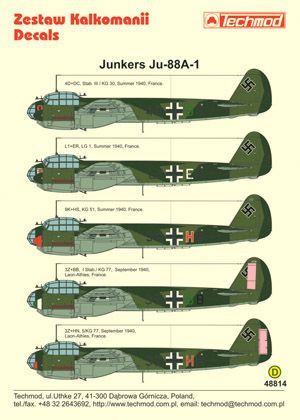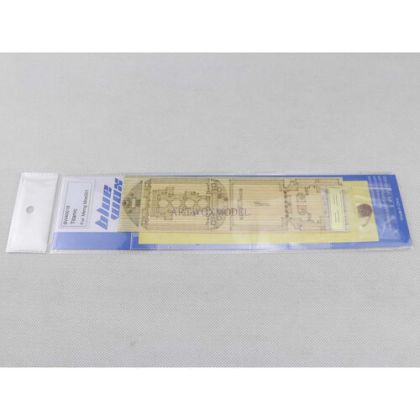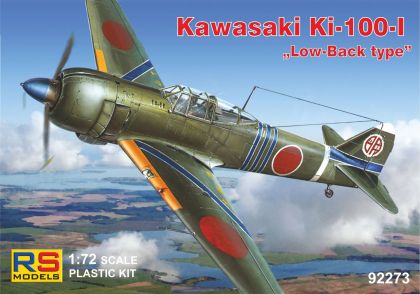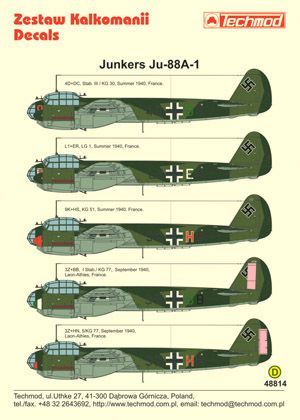
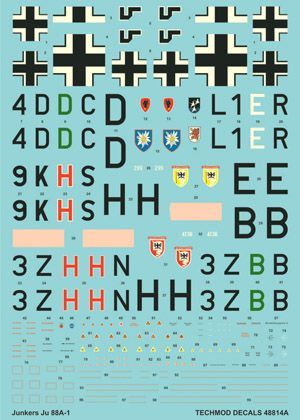
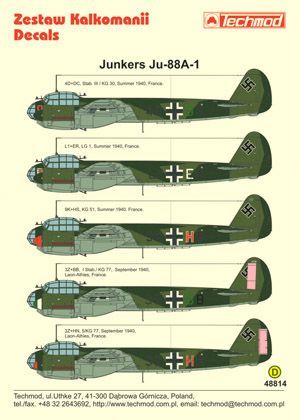
Five markings for the oldest production version of the Junkers Ju 88. All the subjects come from French airfields of the summer and fall of 1940.
Responsibility details are not available.
The A-1 version was the first truly production form of the fast bomber on which the Luftwaffe staked its hopes as a universal weapon. A slender glazed cockpit, an unusually narrow fuselage and lattice dive brakes for attacking in a dive made it a machine that in 1940 had no counterpart in Europe. All five subjects on this sheet come from precisely that summer.
The selection holds together in time as well as in place. Two machines belong to units that in the summer of 1940 took off from France against British targets, and a further pair flew their tasks in the fall of the same year from an airfield in northern France. The unified dating means that the camouflage scheme stays close across all the variants and a modeler does not have to mix several different palettes.
Each aircraft is determined by a combination of two characters for the unit and two for the machine. On this sheet four different formations are represented, so a whole row of models can be built from a single set without the markings repeating. The letters and numerals have different color forms according to the Staffel, which on a model works as a small but pronounced distinguishing feature.
The glazing of the nose has a great many small panels on this type and the markings around it fit tightly. We recommend laying the decals down only on a cured gloss coat and drawing the excess water off carefully, so that the motif does not tear on the sharp edge of one of the frames while it is being settled.
Naši poradci a znalci sortimentu jsou připraveni odpovídat na Vaše dotazy (Po–Pá, 8–18 hod).
Zeptejte se na co potřebujete, odpovíme co nejdříve.
Texts from customers in the advice section reflect solely the opinions and views of the customers. MNF trade s.r.o. does not approve or verify customer texts in advance.
There are no questions here yet. Be the first to ask!