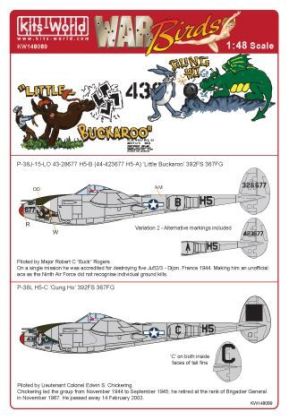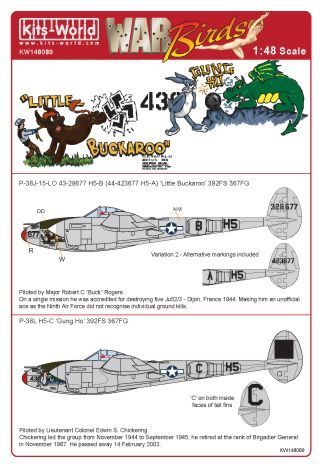
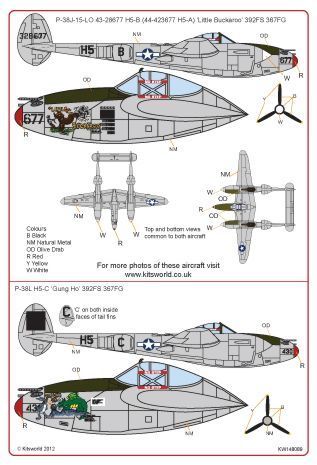
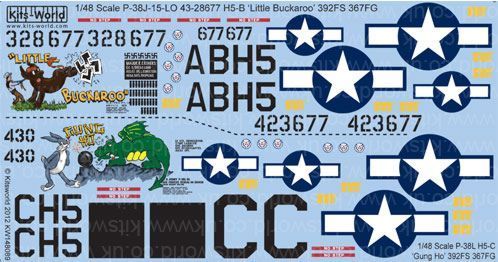
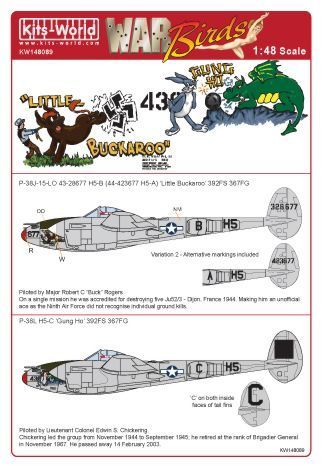
Decals in 1:48 for two Lightnings of the 392nd Fighter Squadron with the codes H5-B and H5-C, the J and L versions on a single sheet.
Responsibility details are not available.
The twin-boom Lockheed P-38 was among the most easily recognized aircraft of the Second World War and at the same time among the hardest to fly. The pair of engines with counter-rotating propellers removed the torque effect, but when one of them failed the machine behaved unforgivingly. In Europe the Lightnings eventually stood out mainly as fighter-bombers against ground targets.
What is unusual about this sheet is that both subjects come from the same unit, the 392nd Fighter Squadron of the 367th Fighter Group. They differ only in the last letter of the code and in the production version. The first is a J version machine from the 15-LO batch with the code H5-B and the name Little Buckaroo, the second an L version with the code H5-C and the name Gung Ho. A modeler can therefore build a pair that really did fly together.
Small lettering: on this type a number of the markings sit on narrow nacelles and on the tail booms, where there is little room to work. It pays off to use flat tweezers with ground tips and to slide the decal into place on a thin film of water rather than laying it down from above.
A pair of models from one squadron looks different in a display case from two randomly chosen machines. Neighboring code letters suggest that the aircraft stood on the same hardstanding and took off on the same missions, and it is exactly that small thing which turns a model into a record of a particular day rather than a sample of a type.
Naši poradci a znalci sortimentu jsou připraveni odpovídat na Vaše dotazy (Po–Pá, 8–18 hod).
Zeptejte se na co potřebujete, odpovíme co nejdříve.
Texts from customers in the advice section reflect solely the opinions and views of the customers. MNF trade s.r.o. does not approve or verify customer texts in advance.
There are no questions here yet. Be the first to ask!