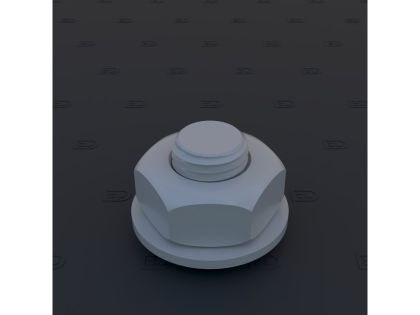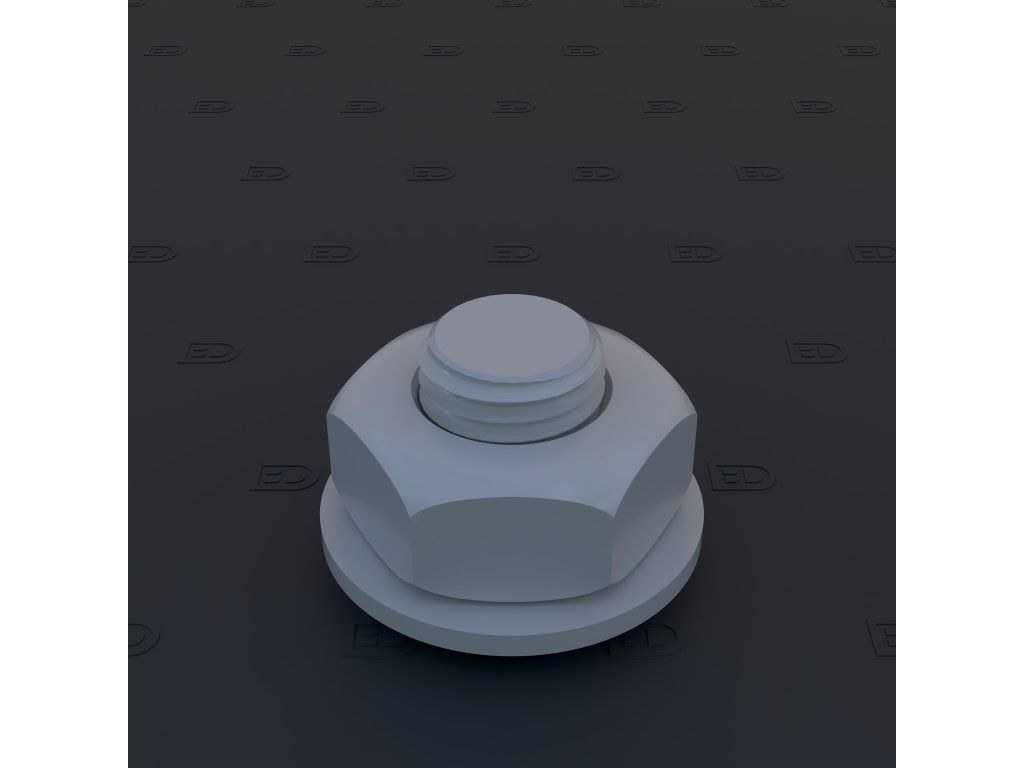
The heaviest grade of the dimensional family: a hex exactly two millimeters wide, complemented by a shank and a washer. Intended for a large scale, where every joint is to be readable even in a photograph taken from a distance.
Responsibility details are not available.
Two millimeters is a fairly large area on a model, and that is precisely why a botched coat shows most on them. Spray the primer thinly so that the edges stay crisp, and only then add a dark glaze which runs into the gap around the washer. That narrow line of shadow turns a glued-on casting into a real bolt; without it even a perfectly seated part looks like a button stuck on.
In 1:16 scale this value corresponds to a thirty-two millimeter head, in 1:12 to twenty-four and in 1:8 to sixteen millimeters. These are therefore joints from chassis anchorages, from axle flanges and from the mounting of blades. In the smaller scales such a dimension cannot be used, but in large car and agricultural models it is among the most frequently reached-for sizes of all.
Before you start, verify on one piece how much glaze the surface will take. Too much of it will trace even the tops of the edges and the joint is visually blurred; too little, on the other hand, leaves the part hanging above the surface. The right state is when the shadow is noticeable only around the circumference of the washer and the upper face of the hex stays light, roughly as nuts look after several years of service.
Naši poradci a znalci sortimentu jsou připraveni odpovídat na Vaše dotazy (Po–Pá, 8–18 hod).
Zeptejte se na co potřebujete, odpovíme co nejdříve.
Texts from customers in the advice section reflect solely the opinions and views of the customers. MNF trade s.r.o. does not approve or verify customer texts in advance.
There are no questions here yet. Be the first to ask!