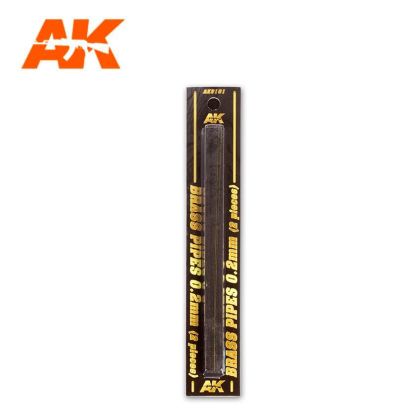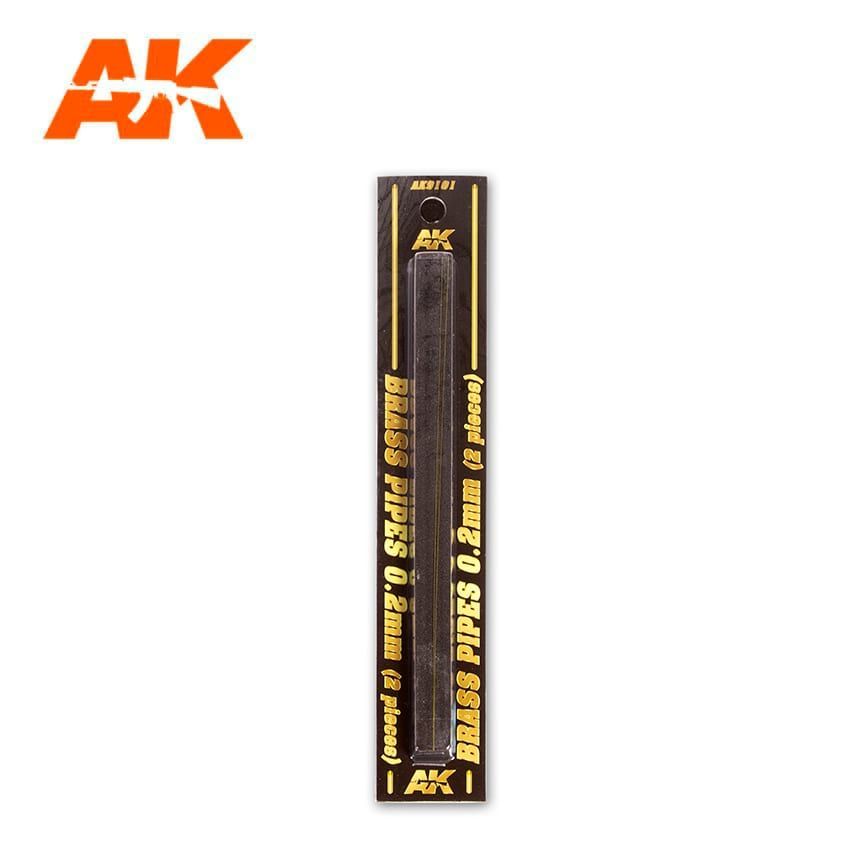
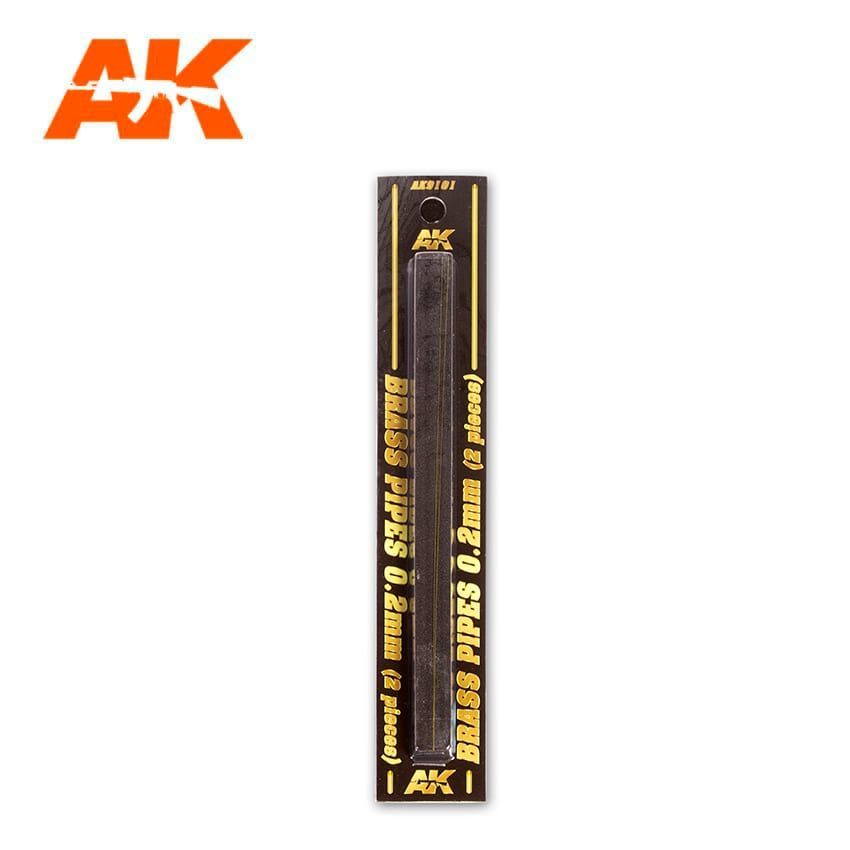
The 0.2 mm brass profile from AK interactive is a modeling material — 2 pieces 20 cm long. The thinnest diameter of the whole range, intended for antennas, probes and the finest lines. It is not a kit.
Responsibility details are not available.
This is a modeling material, not a kit. In the package you will find 2 pieces 20 cm long with an outside diameter of 0.2 mm. The fact that there are only two pieces here — while the thicker diameters of the same range come five to a package — has its logic: a brass profile this thin is more fragile and both its production and handling it are more demanding. Compared with plastic, brass has a fundamental advantage: it is strong and stiff, so it holds its shape, does not sag under its own weight and does not break at a touch the way a stretched plastic thread does. It can moreover be soldered, which is out of the question with plastic.
Never cut the profile by squeezing it with pliers or nippers — it deforms. The correct procedure is with a sharp knife while rotating the profile, or with a fine saw; then tidy the end up inside and out with a fine drill bit or the point of a needle, so that it is clean and straight. A botched cut is precisely the most common mistake that gives the result away. Before painting, degrease the brass and prime it — on smooth metal the paint will otherwise not hold and will peel off. The alternative is to leave the brass exposed, since on its own it looks like metal. Fitting is simple: drill a hole of the matching diameter and glue the profile into it with super glue.
For modelers who want to replace coarse or missing plastic detail with real metal — above all in small scales, where plastic simply cannot be thin enough. Useful for diorama builders and for builders of architectural models as well.
A modeling material, it is not a kit. The profiles have sharp ends — keep out of the reach of children. Protect your eyes when cutting and sanding, and ventilate sufficiently when soldering.
Naši poradci a znalci sortimentu jsou připraveni odpovídat na Vaše dotazy (Po–Pá, 8–18 hod).
Zeptejte se na co potřebujete, odpovíme co nejdříve.
Texts from customers in the advice section reflect solely the opinions and views of the customers. MNF trade s.r.o. does not approve or verify customer texts in advance.
There are no questions here yet. Be the first to ask!
The manufacturer states only the outside diameter and the length — it declares neither the inside diameter nor the wall thickness. The name of the range does say tubes, but in the description the manufacturer speaks of rods as well. Hollowness is therefore not guaranteed; at a diameter as fine as 0.2 mm, count rather on a solid profile. If you need a mouth that is certainly open (a gun barrel with a drilled bore, for example), check it on one piece first.
It follows from the diameter itself. 0.2 mm is the thinnest item of the range — such a profile is more fragile and more demanding both to make and to handle than the thicker sizes. The length of one piece is 20 cm, though, which is amply enough for the fine detail of one model or several.
Do not use nippers, which cut by squeezing. Put a sharp knife to it and rotate the profile as you do so, or use a fine saw. Then tidy the end up with a fine drill bit or a needle. A clean, straight cut is what tells good work from botched work on metal detail.
Straight onto bare metal it does not — smooth brass will not accept paint and it peels off. The profile has to be degreased first (with spirit, for example) and then primed. The second option is not to use paint at all and to leave the brass exposed; as metal it looks entirely natural.