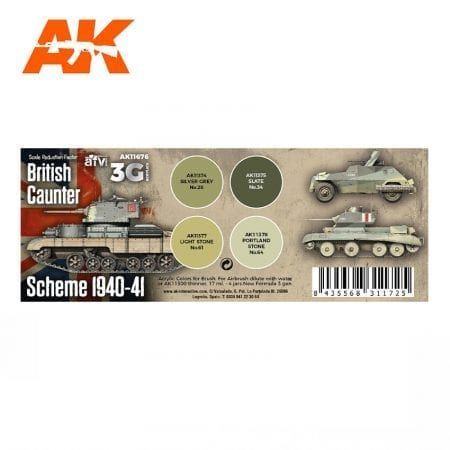

Four acrylic paints of 17 ml for the British desert camouflage of 1940 and 1941: a silvery gray, a slate, a light stone and a Portland stone.
Responsibility details are not available.
British units in North Africa received at the turn of 1940 a peculiar camouflage that appeared nowhere else: sharply broken fields of three colors, drawn across the hull and the turret so as to break the shape of a vehicle into flat areas and to confuse the judging of distance. The pattern carries the name of the brigade commander who pushed it through with his armored unit, and it was used roughly until the end of 1941, before simpler desert finishes replaced it. That is precisely why it is rewarding for modelers who want a vehicle recognizable at first glance.
The procedure has a logic of its own: first the whole vehicle gets a sand base, then the broken boundaries are marked out with a pencil or masking tape and only into them are the remaining fields laid. The transitions are not blended; this pattern is deliberately hard and sharp edges belong to it. Period photographs show that the appearance differed from one example to the next, so exact copying of one pattern is not necessary; it is more important to keep the broken rhythm and the width of the bands.
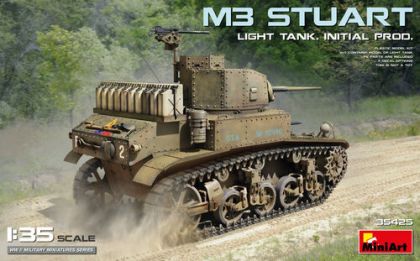
The shades are not tied to armored vehicles alone. The same three colors appeared on trucks, armored cars and the artillery tractors of the same campaign, and the cooler sand tone will serve well on jerrycans, crates and tarpaulins. The paints are intended for a brush as well as a gun; the angular boundaries come out most cleanly, however, when tape is used and the paint is applied in weak layers, so that it does not run under the edge.
Naši poradci a znalci sortimentu jsou připraveni odpovídat na Vaše dotazy (Po–Pá, 8–18 hod).
Zeptejte se na co potřebujete, odpovíme co nejdříve.
Texts from customers in the advice section reflect solely the opinions and views of the customers. MNF trade s.r.o. does not approve or verify customer texts in advance.
There are no questions here yet. Be the first to ask!