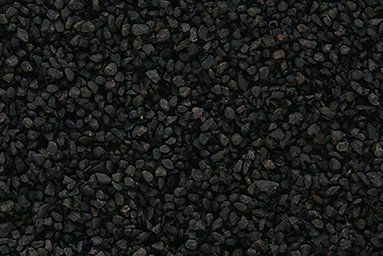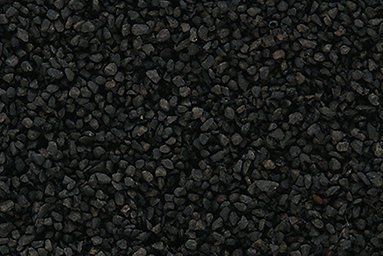
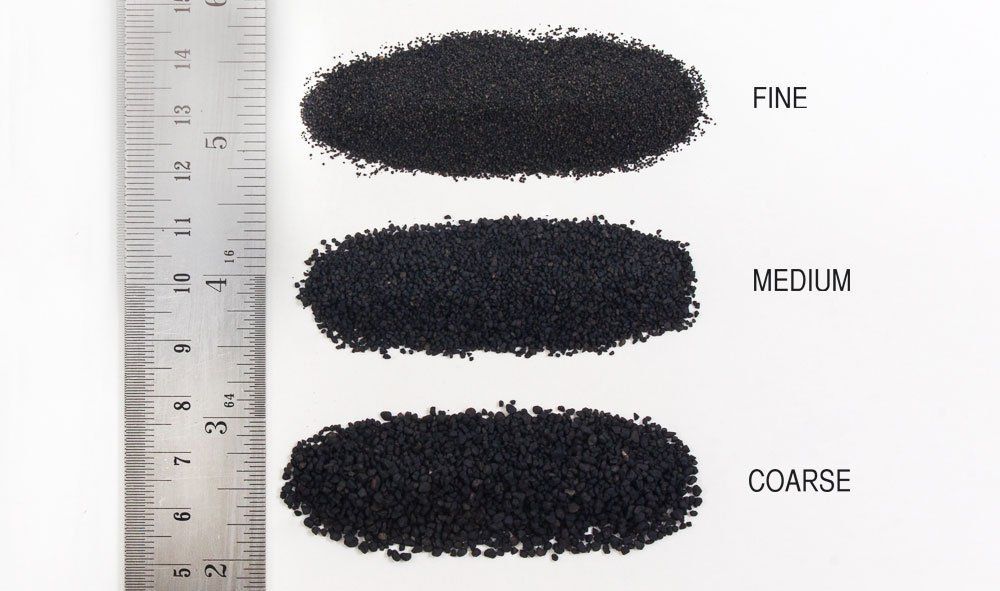
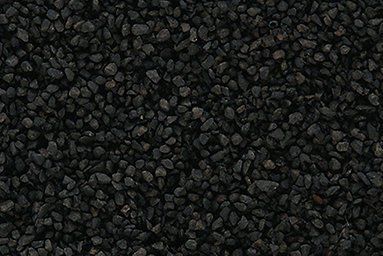
A fine cinders scatter in a dark ashy tone for secondary tracks, depots and the surfaces around coal stores. A 353 cm³ package.
Responsibility details are not available.
The ash-dark material imitates cinders, that is the burned residue of coal, with which surfaces were firmed up in the era of steam locomotives where it was not worth hauling crushed stone. It arose right on the spot, under the grate of a locomotive or in a boiler house, and that is why it was tipped out where it was nearest to hand: onto storage tracks, in engine houses, around coal stores and on the roads about a yard.
A dark material forgives more than a light one: a drop of binder leaves no conspicuous stain on it, so the solution can be applied even with an ordinary pipette all at once. Contrast has to be watched, on the other hand, so that the surface does not merge into uniform black. Light dusting with a lighter powder helps to pull out the texture, or mixing in a smaller share of gray or brown stone before fixing.
On a diorama it pays off to use a dark surface sparingly, because it optically takes space away. Paired with the lighter ballast of a main line, though, it explains at once which track is the main one and which is for storage. The bag holds 353 cm³ of loose material.
If you are building a scene from the time after steam working ended, the cinders do not disappear from the view straight away. They stay under the newer ballast and give themselves away in the gaps and at the edges of surfaces; a thin dark band along the new layer is therefore more accurate than a uniform surface.
Naši poradci a znalci sortimentu jsou připraveni odpovídat na Vaše dotazy (Po–Pá, 8–18 hod).
Zeptejte se na co potřebujete, odpovíme co nejdříve.
Texts from customers in the advice section reflect solely the opinions and views of the customers. MNF trade s.r.o. does not approve or verify customer texts in advance.
There are no questions here yet. Be the first to ask!