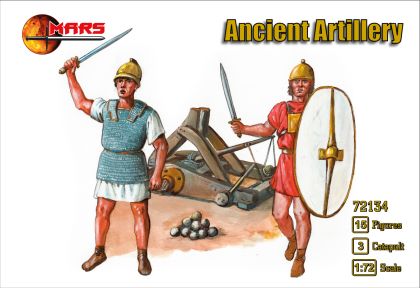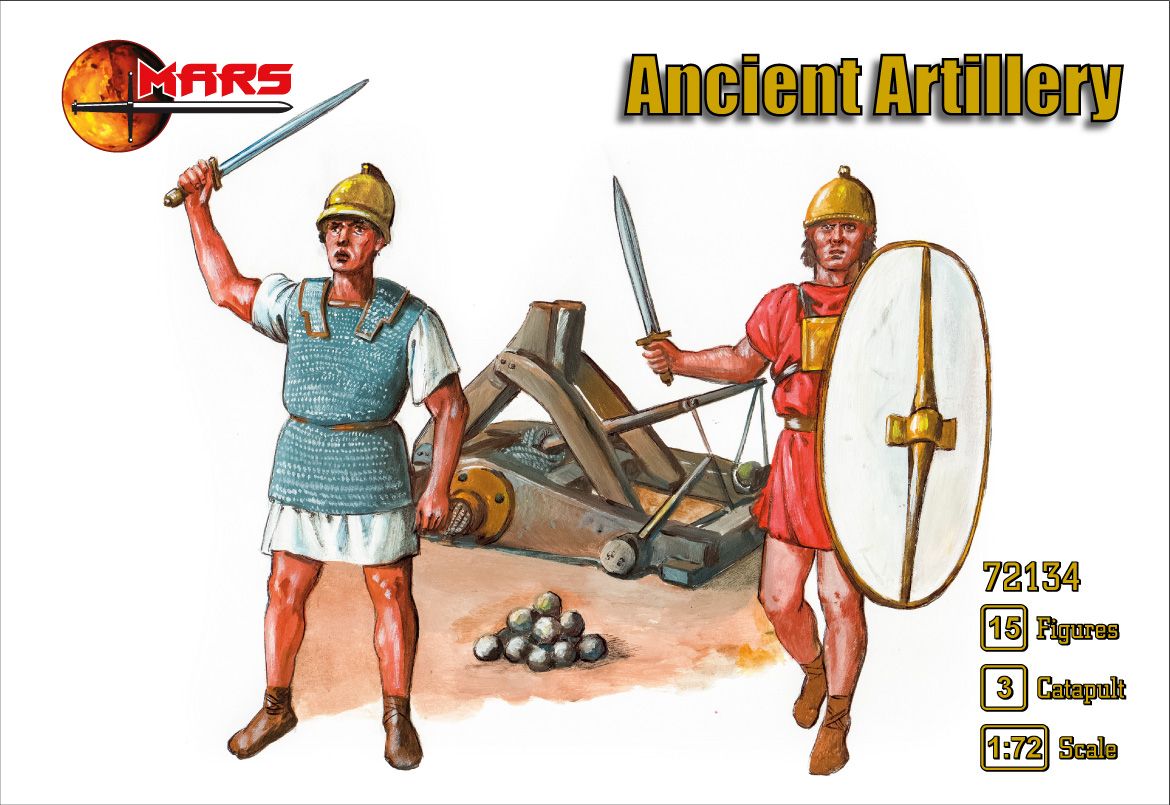
Roman throwing engines in 1:72 scale together with their crews. The torsion artillery of the legions covered the advance of an army, sieges and the fortified camps on the frontiers.
Responsibility details are not available.
Ancient artillery did not work with powder but with energy gathered in bundles of twisted sinew or horsehair. Two such torsion springs drew the arms of a shooting frame, and once the catch was released they flung the missile with surprising force. According to Vegetius, every legion was to have its own park of these weapons and expertly trained crews.
The smallest was the scorpio, in essence a giant crossbow on a stand, which sent heavy bolts several hundred paces and was used to silence enemy commanders. The larger ballista threw stone balls and was the basis of a siege park. The onager, literally the wild ass, took its name from the violent recoil that lifted the engine as it fired. A later lighter version on a two-wheeled carriage, called the carroballista, could keep pace with a marching column.
Weapons of this type accompanied the Roman army from the late Republic practically to the end of the Western empire, that is for about five centuries. They were used at the siege of Jerusalem in the year 70, in the Dacian campaigns and in the defense of the frontier fortresses along the Rhine and the Danube.
Besides the engines themselves, the set holds gunners in tunics and scale cuirasses in working postures. The smaller parts of the arms and the stands call for careful separation and straight seating, otherwise the engine does not stand upright. In color, the set is brought to life by the contrast of wood, ropes and metal fittings.
Naši poradci a znalci sortimentu jsou připraveni odpovídat na Vaše dotazy (Po–Pá, 8–18 hod).
Zeptejte se na co potřebujete, odpovíme co nejdříve.
Texts from customers in the advice section reflect solely the opinions and views of the customers. MNF trade s.r.o. does not approve or verify customer texts in advance.
There are no questions here yet. Be the first to ask!