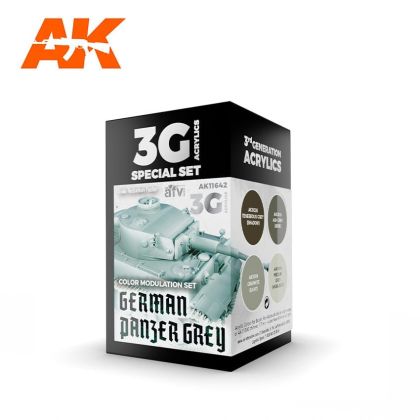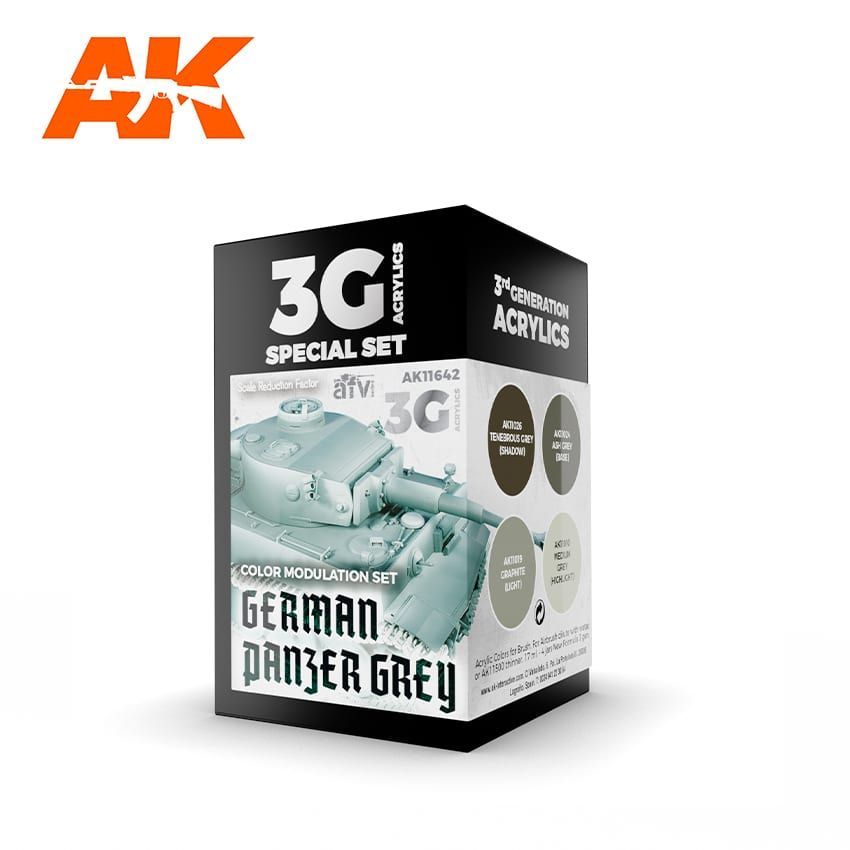
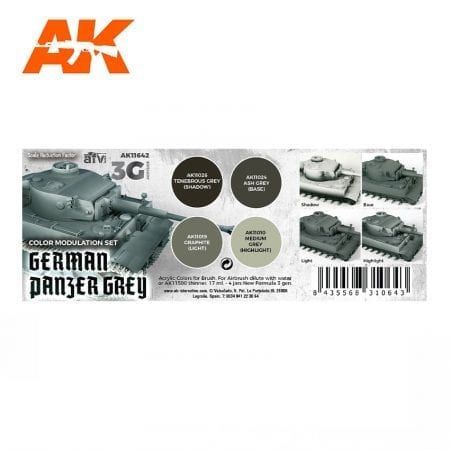
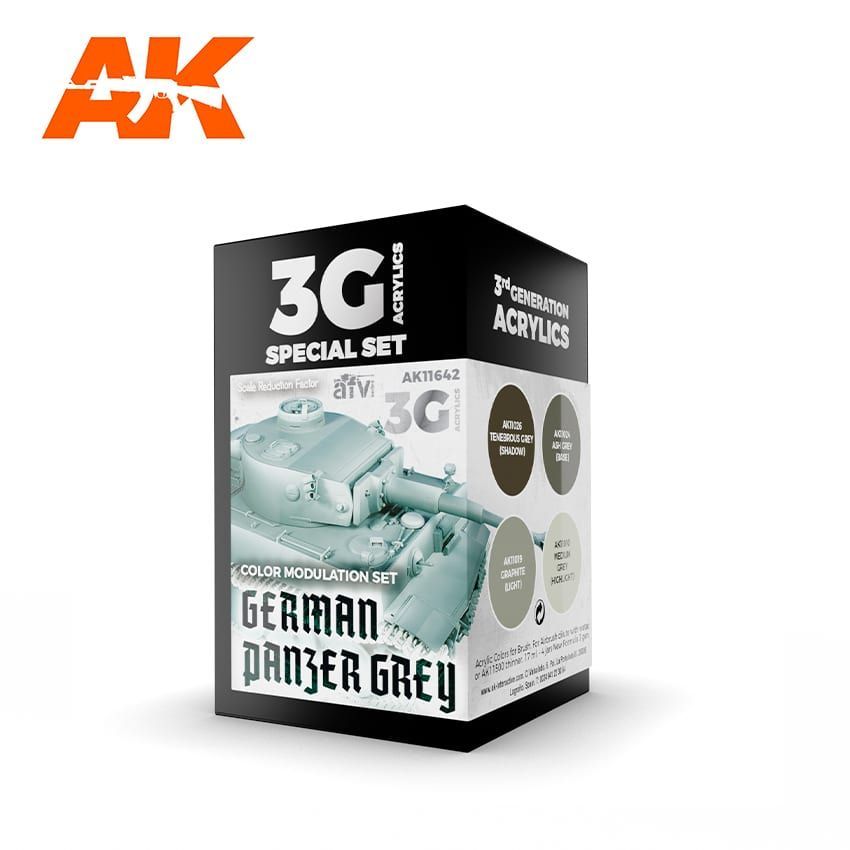
Four shades of dark gray ordered from shadow to light for the modulated spraying of German armored vehicles.
Responsibility details are not available.
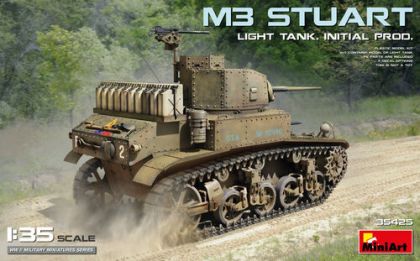
The dark gray finish went with German armored vehicles from the prewar exercises through Poland, France and the Balkans to the first winter before Moscow. The regulation originally called for an additional dark brown, but that was dropped as early as 1940, so the vehicles ran in a single color. Only the order of February 1943 replaced the gray with dark yellow, and the gray finish disappeared from production, even though it survived in the units for a long time afterwards.
A single-color machine is a trap for a modeler: scaled down it loses depth and looks flat. Modulation gives that back by breaking one shade into several tones according to how much light a given place would really receive. Horizontal surfaces get the lightest tone, the sides the middle one, and the corners under the fenders and between the wheels the darkest.
The box offers exactly four water-thinnable acrylics in that order: the darkest tone for the shaded places, the base gray for the overall surface, a lightened variant and finally the lightest shade for the edges and the upper armor. They are applied with an airbrush in very thin coats so that the transitions stay smooth; anyone who wants an even finer break adds a drop of the previous tone to the lighter one. Deliberately overstate the contrast, because the later washes, pigments and final coat will knock it down again. Modulation is not used on accessories such as tools, jerrycans and cables, otherwise the result stops looking like one vehicle.
Naši poradci a znalci sortimentu jsou připraveni odpovídat na Vaše dotazy (Po–Pá, 8–18 hod).
Zeptejte se na co potřebujete, odpovíme co nejdříve.
Texts from customers in the advice section reflect solely the opinions and views of the customers. MNF trade s.r.o. does not approve or verify customer texts in advance.
There are no questions here yet. Be the first to ask!