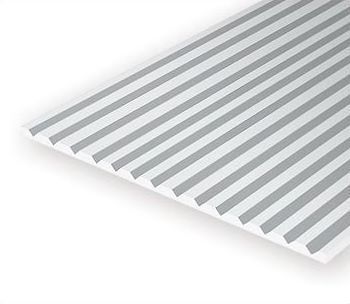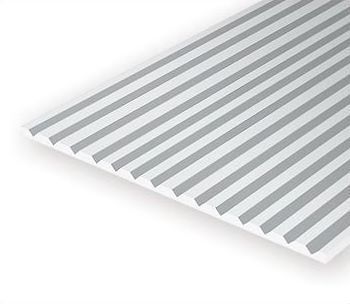
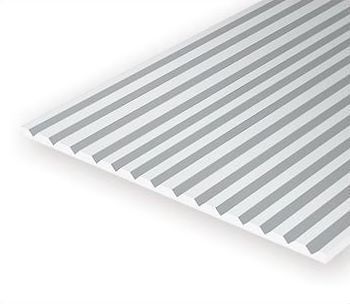
A styrene sheet with milled V-shaped grooves. Thickness 0.50 mm, groove spacing 1.3 mm, depth 0.30 mm.
Responsibility details are not available.
A sheet of white polystyrene with a regular pattern of sharp-bottomed V-shaped grooves milled across its entire surface. The material is only five-tenths of a millimeter thick, so it can be cut with tin snips, scored with a knife and snapped, and still holds flat without warping once glued to a frame.
The spacing between individual grooves is one and three-tenths of a millimeter. In 1:35 scale, that works out to a board roughly five centimeters wide; in 1:48, a bit over six; and in 1:72, almost ten. Depending on the scale, then, the same sheet can represent narrow deck planking in one case and a shed's plank wall in another.
Typically for the clad walls of farm buildings, barn doors, truck-bed planking, station platform decking, fence panels, or wooden diorama floors. The regularity of machine-cut grooves is something hand-scribing can barely achieve, and the shadow the sharp groove bottom casts makes the surface look optically deeper.
Joints hold with ordinary solvent-based polystyrene cement. To keep a wall from looking like a single molded slab, it pays to deepen a few grooves with a blade, randomly wave the edges, and suggest missing knots with the tip of a scalpel. The surface takes both acrylic and lacquer paints, but it's best to start with a thin primer: without it, pigment pools in the groove and the flat surface dries differently from the groove bottom. A thinly mixed dark wash is then enough to bring out the settled layer at the bottom.
Naši poradci a znalci sortimentu jsou připraveni odpovídat na Vaše dotazy (Po–Pá, 8–18 hod).
Zeptejte se na co potřebujete, odpovíme co nejdříve.
Texts from customers in the advice section reflect solely the opinions and views of the customers. MNF trade s.r.o. does not approve or verify customer texts in advance.
There are no questions here yet. Be the first to ask!