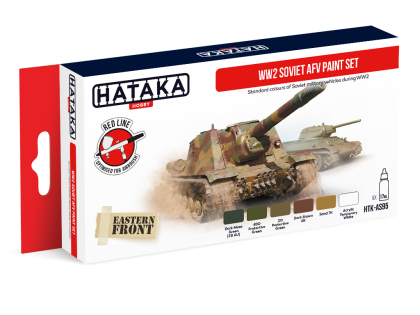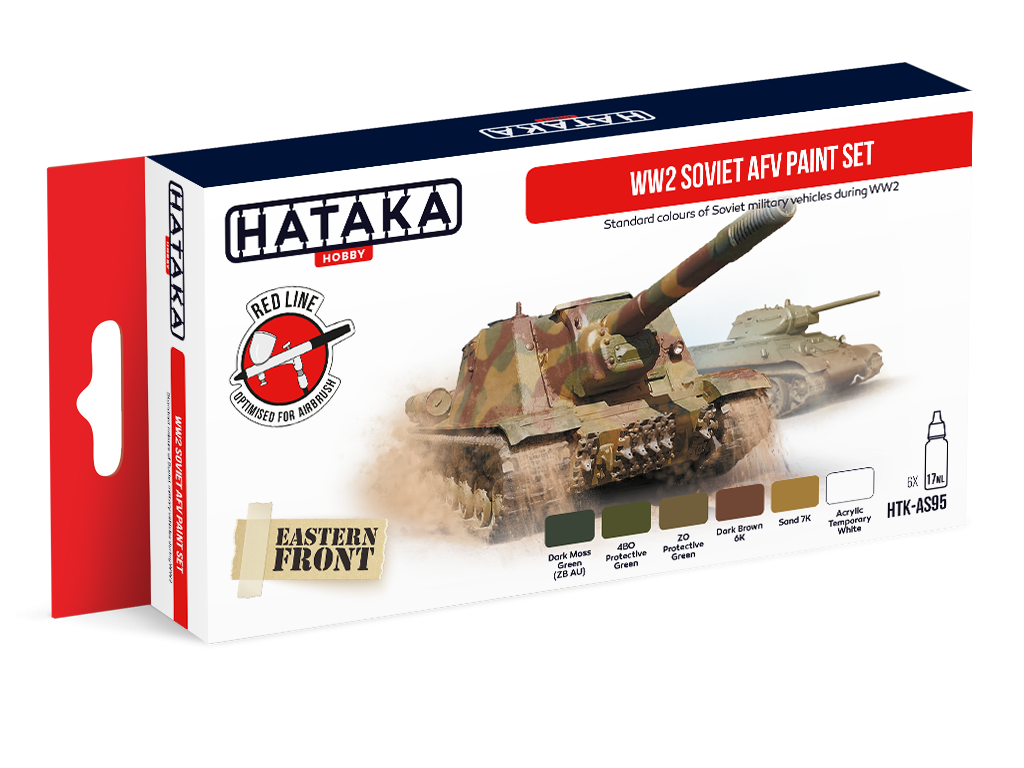
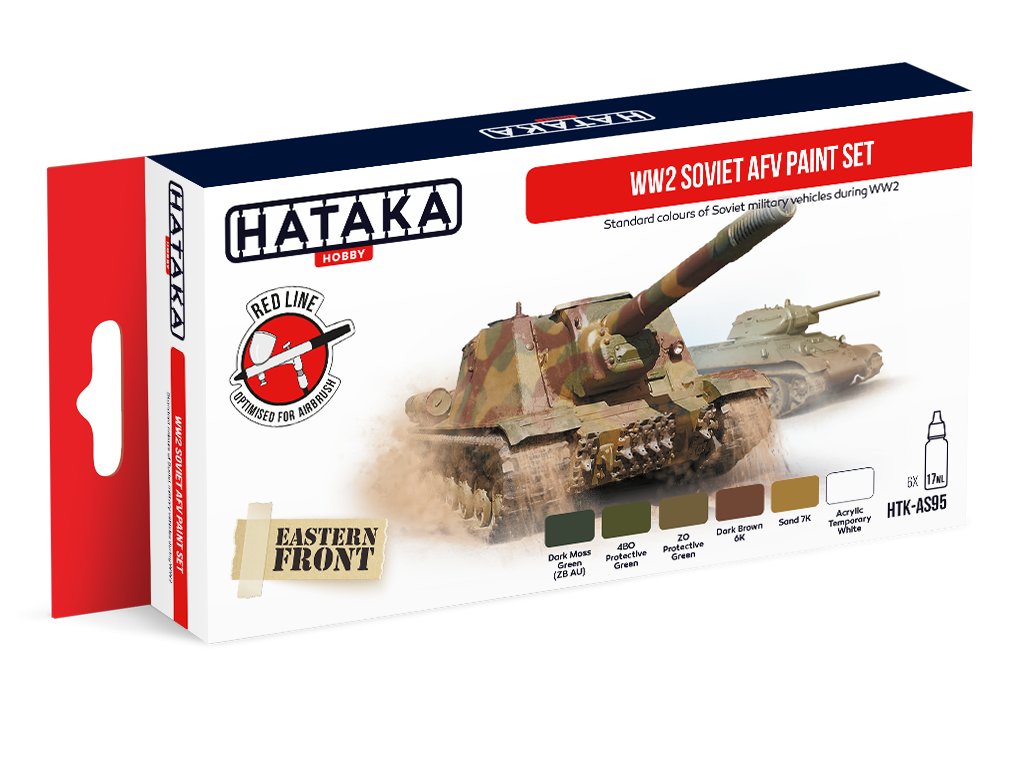
An acrylic six for Soviet armored vehicles: the basic protective greens, brown and sand for three-color camouflage and a washable winter white.
Responsibility details are not available.
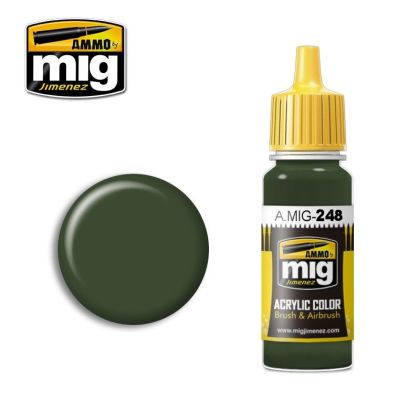
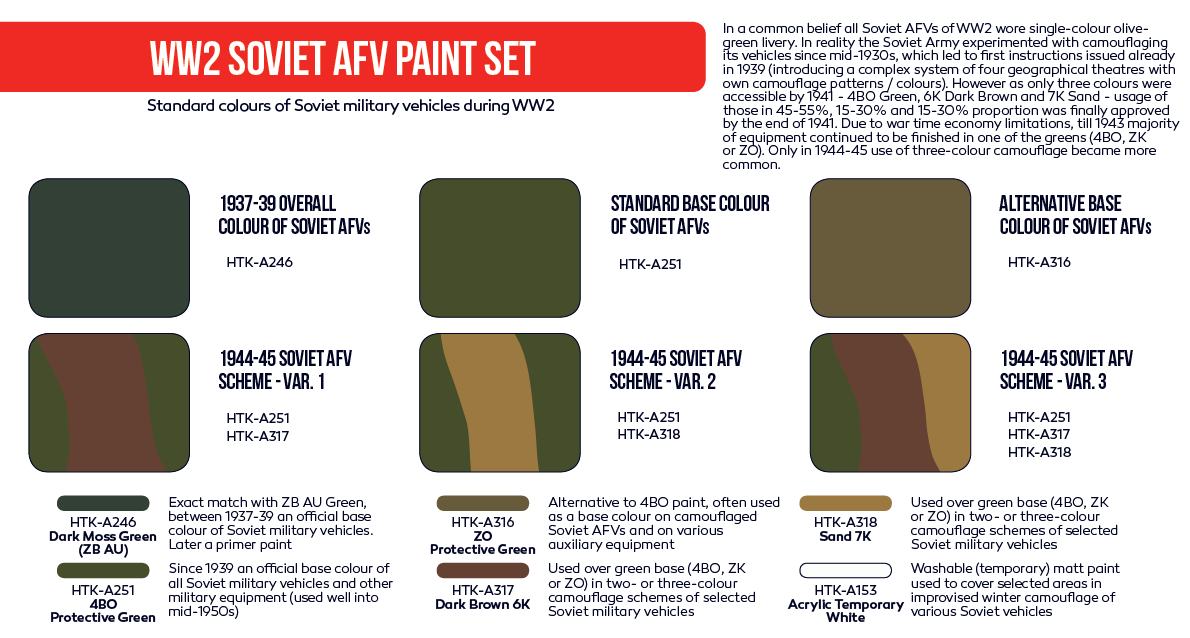
The core of the palette is 4BO Protective Green, the protective green introduced in 1939 as the compulsory finish of all Soviet military vehicles and used well into the 1950s. It is preceded by the older Dark Moss Green to the ZB AU standard, which between 1937 and 1939 was the basic shade and afterwards served mainly as an undercoat. The third green is ZO Protective Green, an alternative to 4BO, which can be met on camouflaged tanks and on support vehicles.
Onto the green ground, Dark Brown 6K and Sand 7K were applied in two-color and three-color patterns. It was not a scheme ordered across the board but a solution used only by selected units, which gives a modeler freedom in laying the patches out. The last bottle holds Acrylic Temporary White, the equivalent of the whitewash finish with which crews hastily covered parts of a vehicle for a winter campaign. With that one it makes sense to work in layers: apply it thinly, let the green show through and let the finish scuff at the edges, as befits improvised camouflage.
The paints belong to the water-based acrylic range and their consistency is built for an airbrush nozzle. Apply them in thin passes, so that the fine cast surfaces of the turret and the hull stay visible. A short pause between coats is enough; full curing takes a few hours. Anyone building a vehicle from the first months of the fighting will manage with the undercoat green and the winter white; later machines call for the whole three camouflage tones.
Naši poradci a znalci sortimentu jsou připraveni odpovídat na Vaše dotazy (Po–Pá, 8–18 hod).
Zeptejte se na co potřebujete, odpovíme co nejdříve.
Texts from customers in the advice section reflect solely the opinions and views of the customers. MNF trade s.r.o. does not approve or verify customer texts in advance.
There are no questions here yet. Be the first to ask!