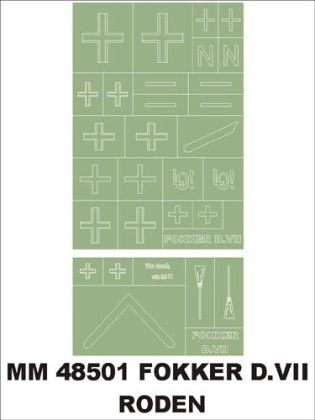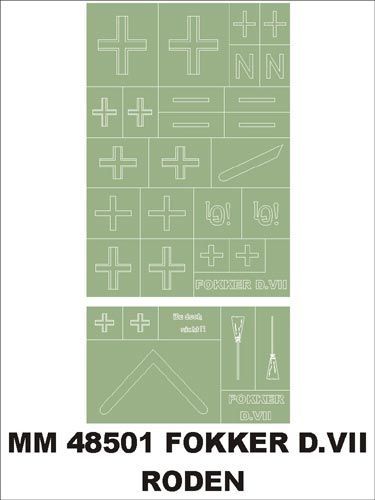
A pair of national insignia masks for the German fighter of the end of the First World War. The crosses are sprayed in paint straight onto the fabric.
Responsibility details are not available.
The Fokker D.VII reached the units in the spring of 1918 and within a few weeks became the most feared German fighter. It forgave mistakes, held a steep climb and hung on the propeller at low speed where opponents fell away. Its reputation is documented by an unusual detail: the text of the armistice of November 1918 names this very type among the material Germany had to hand over.
An open cockpit means that a masking set here has no canopy to work on. The package therefore carries two national insignia masks and nothing else. That is not a shortfall but the nature of the subject. And it is precisely on machines with fabric covering that a sprayed cross is markedly better than a decal: the fabric follows the ribs and the tapes, a decal breaks over that undulation and a silvery film appears under it once it is dry. Paint sprayed over a mask knows no such trouble.
The procedure is simple. First paint the area in the base color, let it dry thoroughly and only then lay the film on. Apply the color of the marking in two thin mists at right angles to the surface, so that it does not get under the edge. Lift the mask shortly after spraying, while the paint is not yet fully hard, and by pulling sideways rather than up.
Naši poradci a znalci sortimentu jsou připraveni odpovídat na Vaše dotazy (Po–Pá, 8–18 hod).
Zeptejte se na co potřebujete, odpovíme co nejdříve.
Texts from customers in the advice section reflect solely the opinions and views of the customers. MNF trade s.r.o. does not approve or verify customer texts in advance.
There are no questions here yet. Be the first to ask!