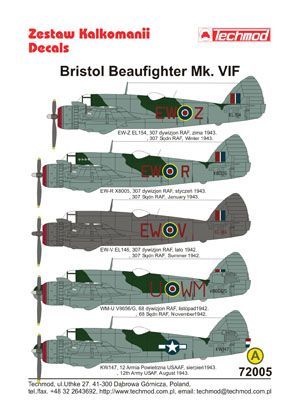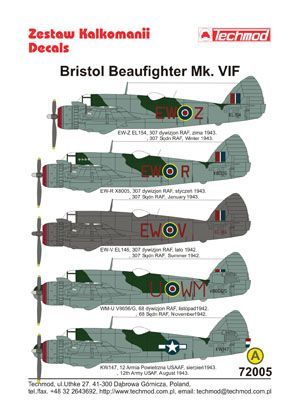
The heavy twin-engine Bristol Beaufighter VI in five forms. Three of them belong to a Polish night fighter squadron, the remaining two to a British and an American unit.
Responsibility details are not available.
The Beaufighter came about by rebuilding a torpedo bomber, and its squat nose without glazing hid four cannons. In the VI version it was given more powerful engines and radar, thanks to which it became one of the first truly effective night fighters. British, Allied and American units in the Mediterranean used it for the same task.
Half the range belongs to a squadron made up of Polish airmen that patrolled over western England under British command. Its three machines are dated the summer of 1942, January 1943 and the winter of 1943, so they can be built as a small time series of one unit. The remaining two markings fall to a British squadron of November 1942 and to an American formation operating in August 1943 in the Mediterranean.
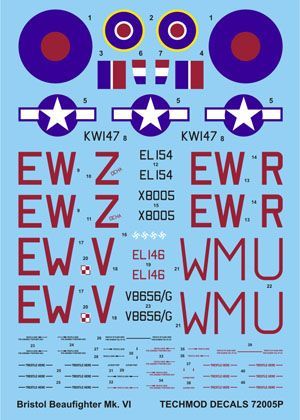
The documentation lists no masks or photo-etched components for this item, so it is a pure sheet of markings. The subjects are described by unit and by a date; serial numbers are not given for them, which is usual with night machines.
A night scheme tends to be almost entirely black and matte, which is the most unfavorable surface for a film there is. A glossy intermediate layer is a necessity here, not a recommendation. Once the motif has settled, the excess water is drawn off and the area is left to dry overnight; only then does the final matte spray become the turn. Hurried matting down is the most frequent cause of a spoiled night camouflage.
Naši poradci a znalci sortimentu jsou připraveni odpovídat na Vaše dotazy (Po–Pá, 8–18 hod).
Zeptejte se na co potřebujete, odpovíme co nejdříve.
Texts from customers in the advice section reflect solely the opinions and views of the customers. MNF trade s.r.o. does not approve or verify customer texts in advance.
There are no questions here yet. Be the first to ask!