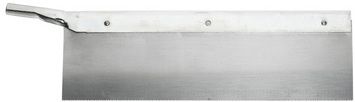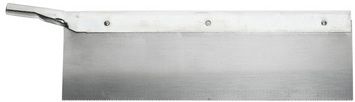
A spare Excel pull saw blade with a depth of 1 1/2 inches and fine teeth at 30 teeth per inch. A pull saw cuts on the pull toward you, which gives a calm and accurate cut.
Responsibility details are not available.
A pull saw works the opposite way round from an ordinary wood saw. It cuts on the pull toward you, not on the push away from you. The difference is fundamental: during the cut the blade is in tension rather than in compression, so it does not buckle, does not skip and holds its line. That is exactly why a pull saw is popular in modeling wherever a straight cut is needed in a place that cannot be put right. The designation of this blade gives a depth of 1 1/2 inches, that is roughly 38 mm, and a tooth pitch of 30 teeth per inch.
What 30 teeth per inch means
It is a statement about fineness. The more teeth there are to an inch, the smaller each tooth is and the finer and smoother the cut, though also the slower. Thirty teeth per inch is among the fine values, which suit exactly what a modeler cuts most often: thin plastic, a cast block of resin, stock sections, a thin metal rod. A coarse saw would tear such material and leave fraying, while a fine one goes through it with a smooth wall of cut that then needs only a light sanding.
How to work with it
The designation of this blade does not give which handle or holder it belongs to, nor how many pieces are in the package. Before ordering the blade, please compare the way it is held with your own tools. With spare blades a fitting that does not match is by far the most common reason the goods cannot be used in the end.
For modelers who separate parts, cut casting blocks off resin parts and need a straight cut where a knife would run off.
Naši poradci a znalci sortimentu jsou připraveni odpovídat na Vaše dotazy (Po–Pá, 8–18 hod).
Zeptejte se na co potřebujete, odpovíme co nejdříve.
Texts from customers in the advice section reflect solely the opinions and views of the customers. MNF trade s.r.o. does not approve or verify customer texts in advance.
There are no questions here yet. Be the first to ask!