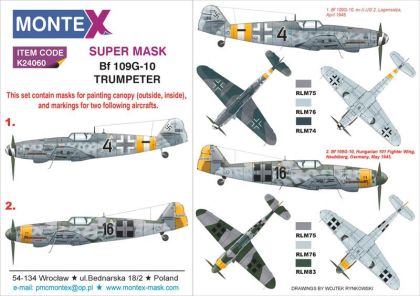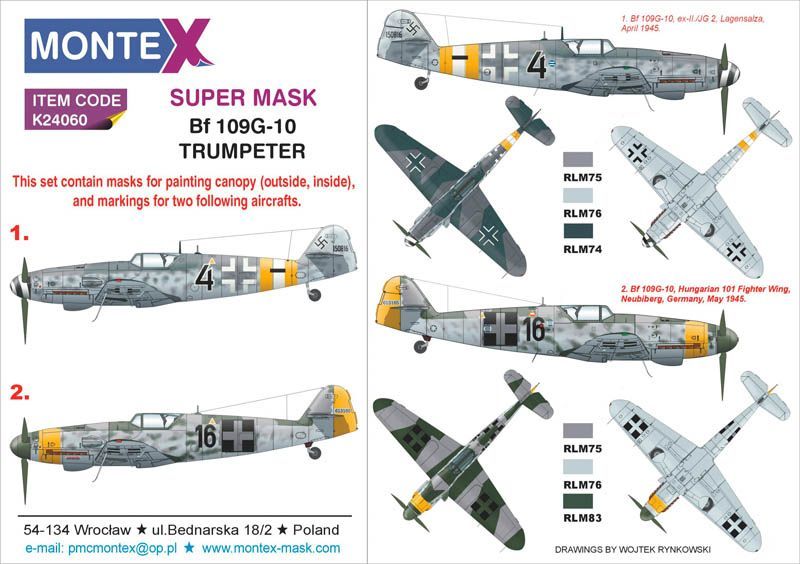
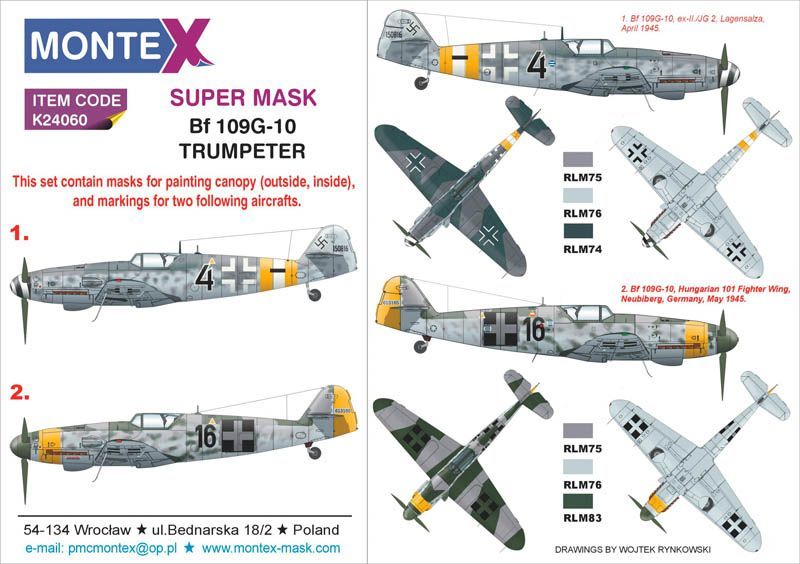
The late Messerschmitt G-10 in a large scale gets precisely cut films for the canopy, from the face and the back, plus four marking masks.
Responsibility details are not available.
The shape of the G-10 came about at the end of 1944 and was an attempt to get something more out of an established design. It was given a more powerful engine of the 605 series in the D form, and with it a reworked powerplant cowling that looks smoother than on the older machines. Most of these aircraft carried the bulged sliding canopy without a central frame, which was called the Erla Haube. Thanks to it pilots could at last see behind them, and modelers got a single continuous bulged surface.
In 1:24 scale the inside of the canopy is just as much in view as the outside. The frames tend to be painted a different shade inside from outside, usually a lighter interior tone, and if they are painted only from the outside the cockpit looks, seen through the glass, like a transparent box with no framework. The way to go about it is to stick on the inner parts first, spray the interior shade, let the clear part dry thoroughly and only then take the outer masking and the camouflage coat in hand. The inner film can be left in place right to the end of the build; it protects the glass from overspray.
Two parts for the glazing, one outer and one inner, plus four masks for the national insignia. The outer part assumes that the frames will be sprayed together with the camouflage of the whole airframe, so the shade on the cockpit matches the shade on the spine of the fuselage exactly. A hand-painted frame never hits that match, and seen from above it jars more than anything else.
Naši poradci a znalci sortimentu jsou připraveni odpovídat na Vaše dotazy (Po–Pá, 8–18 hod).
Zeptejte se na co potřebujete, odpovíme co nejdříve.
Texts from customers in the advice section reflect solely the opinions and views of the customers. MNF trade s.r.o. does not approve or verify customer texts in advance.
There are no questions here yet. Be the first to ask!