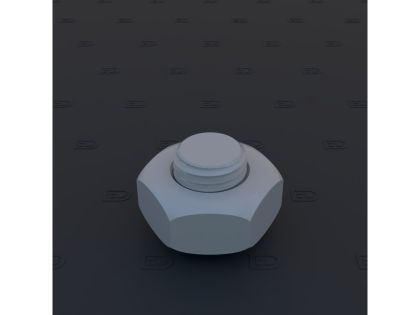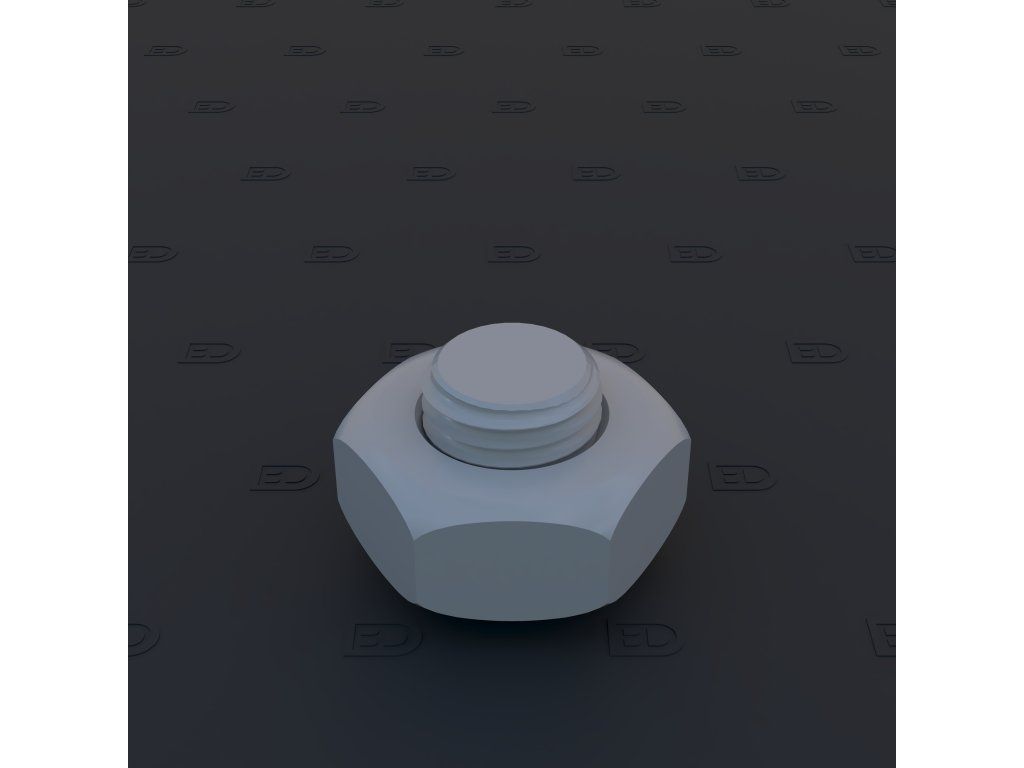
Twelve tenths of a millimeter across the flats of the hex, a nut with a short shank. The last grade that still falls into the lower half of the scale offered, and at the same time the highest of the dimensions suitable for 1:35.
Responsibility details are not available.
The most common mistake with add-on joints is not the wrong size but a joint where there was none on the real machine. Before you start gluing, find a shot of the subject and go over the surface with your eyes: where the flanges are, where the welds are, where the sheet metal is smooth. Welds and pressed edges, after all, are not adorned with bolts, whereas the mounting of carried parts is, and the difference between the two is recognized even by a viewer who knows nothing about machinery.
In 1:35 you get a joint forty-two millimeters across, which is already at the limit of what commonly occurs on a real vehicle. In 1:24 it is just under twenty-nine millimeters and in 1:16 nineteen, that is an entirely ordinary wrench size. That is precisely why this grade is the highest that still makes sense in 1:35.
Something that cannot be read from a photograph can be verified too. If no shot of the subject exists, go by the logic of the structure: what is bolted is what can be taken off, and that usually means hatches, covers, flanges, hinges and equipment carriers. A continuous sheet in the middle of a side stays smooth. Restraint wins here, because an overloaded surface looks worse than a surface that is missing a few details.
Naši poradci a znalci sortimentu jsou připraveni odpovídat na Vaše dotazy (Po–Pá, 8–18 hod).
Zeptejte se na co potřebujete, odpovíme co nejdříve.
Texts from customers in the advice section reflect solely the opinions and views of the customers. MNF trade s.r.o. does not approve or verify customer texts in advance.
There are no questions here yet. Be the first to ask!